

Longitudinal client progress data is quantitative information collected consistently and repeatedly across the full span of a coaching or therapy engagement to track how a client changes over time. Unlike a single intake assessment or a one-off session note, this approach captures a running record of psychological, emotional, and functional status at regular intervals, often session by session. The American Psychological Association’s 2025 guidelines describe this practice through the lens of Measurement-Based Care (MBC), defining it as “a clinical process that uses quantitative data to allow clinicians and patients to track patient progress.” One distinction worth making early: a session progress note records what happened in a single meeting, while a longitudinal tracking log captures patterns of change across the entire engagement.
Key elements of longitudinal client progress data include:
- Repeated measures collected at regular intervals, not just at intake or discharge
- Objective tracking of psychological, emotional, social, and functional status
- Session-by-session or periodic questionnaires that feed psychometric data back to the practitioner
- A dedicated progress log separate from session notes, capturing milestones and recurring patterns
Why tracking client progress longitudinally improves outcomes
The clinical case for longitudinal data collection is grounded in research, not theory. Routine Outcome Monitoring (ROM) systems produce a statistically significant average advantage in client outcomes, with a modest but clinically relevant benefit beyond standard therapy delivery. That gain comes specifically from identifying clients who are failing to improve before the situation worsens.
Repeated measurement does several things a single assessment cannot:
- Catches early signs of stagnation or deterioration, enabling timely course corrections
- Supports personalized interventions, especially for clients at risk of treatment failure
- Builds client motivation by making progress visible and concrete
- Creates a foundation for collaborative goal-setting between practitioner and client
Statistic spotlight: A 2023 research review found ROM adds a meaningful benefit over standard therapy, with an average effect size of g ≈ 0.15, a modest but clinically relevant gain when applied consistently across a caseload.
How MBC and ROM frameworks structure longitudinal data collection
Measurement-Based Care and Routine Outcome Monitoring are the two dominant clinical frameworks built around longitudinal data. They share a core structure while differing in emphasis.
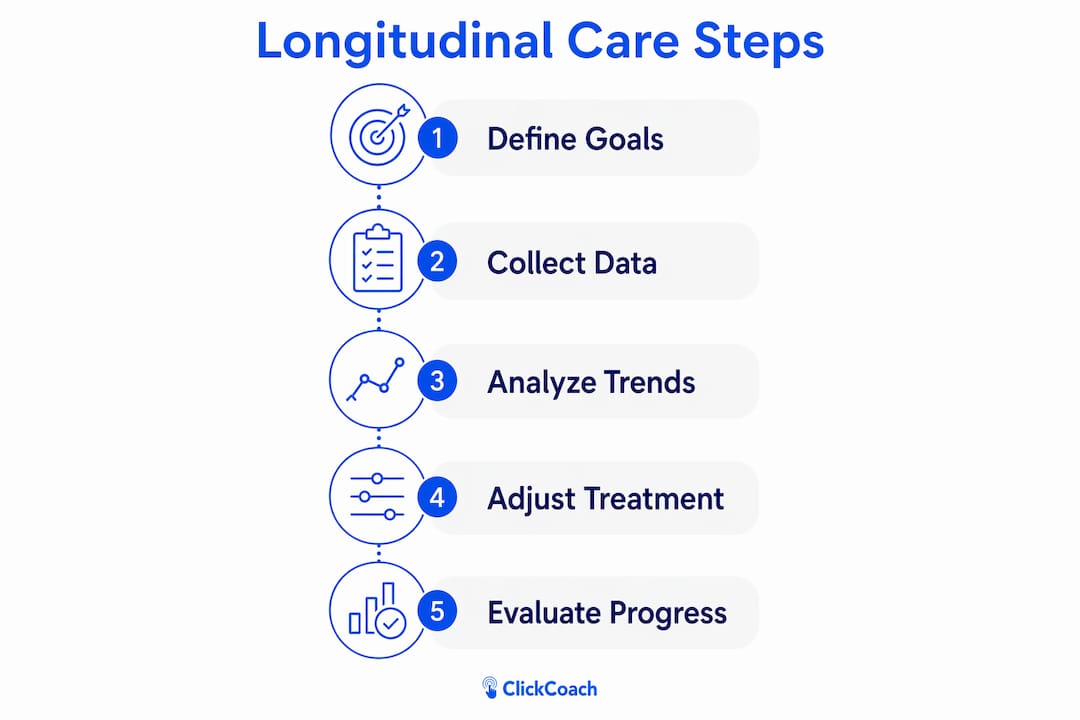
MBC is the broader clinical process. As Jessica Barber, PhD, assistant clinical professor at the Yale University School of Medicine, explains, measures are “administered regularly and repeatedly, and that information helps inform treatment decisions and goal setting.” The process is not about rigid questionnaire protocols; practitioners choose from a wide range of psychometrically sound tools covering depression, anxiety, functionality, well-being, and therapeutic alliance.
ROM operationalizes MBC through three sequential phases:
- Collect: Administer standardized outcome measures on a session-by-session or regular basis
- Share: Feed data back to the practitioner and, often, the client through graphs and brief discussions
- Act: Adapt the process or focus of treatment based on what the data reveals
Patients show higher acceptance of outcome monitoring when it is clearly integrated into the therapeutic relationship rather than presented as an administrative task. That framing matters from the very first session.
Practical steps for implementing longitudinal data tracking in your practice
Getting started with longitudinal tracking does not require an overhaul of your practice. A stepwise approach works best.
- Select a suitable measure that is psychometrically sound, brief, and clinically practical for your client population
- Introduce it early, ideally in the first session, with a clear rationale so clients understand why they are completing it
- Collect data frequently because sufficient data density is what allows you to spot deterioration patterns at the earliest opportunity
- Use a simple repeatable cycle (clarify, act, observe, reflect, adjust) to capture client shifts without turning sessions into data-entry exercises
- Visualize the data using graphs, since data visualization tools improve client understanding and connect scores to treatment options
Pro Tip: Keep a dedicated longitudinal progress log that is entirely separate from your session notes. Session notes capture what happened in the room. The progress log captures patterns across the whole engagement, recurring themes, consistent growth areas, and places where the client keeps getting stuck. That distinction is what makes end-of-engagement reviews genuinely meaningful.
Barkham and colleagues’ 2023 review reinforces that explaining the rationale behind data collection early significantly improves client buy-in. When clients understand the purpose, they engage with the process rather than tolerating it.
How longitudinal data shapes treatment decisions and client collaboration
Objective longitudinal data gives practitioners and clients a shared basis for deciding whether to stay the course, adjust the intervention, or refer to another provider. That joint decision-making is one of the most clinically valuable outcomes of consistent tracking.
When a client’s scores plateau or decline, the data creates a natural opening for a direct conversation rather than a vague sense that something is off. Practitioners can use graphs to show clients exactly where progress has stalled, which tends to increase trust rather than alarm. Data-informed therapies use feedback and clinical support tools to identify treatment barriers and adapt plans, improving outcomes specifically for clients at risk of not responding to standard approaches.
Real-world examples of longitudinal tracking in action
One of the clearest examples comes from a Calgary-based mental health center described in APA’s 2025 coverage of MBC. All clinical staff use the same measurement system, the Outcome Questionnaire, administered before each session. Over a decade of longitudinal data, one therapist discovered that clients who completed individual counseling followed by 14 weeks of group therapy were no longer depressed at treatment’s end, while those who only received individual counseling remained less depressed but did not clear the clinical threshold. That finding would have been invisible without long-term data.
In coaching contexts, a similar principle applies. When a coach tracks a client’s confidence ratings and commitment scores across a 12-week engagement using a GROW-structured session format, patterns emerge that memory alone would miss. A client circling the same obstacle for four sessions becomes visible in the log, creating a direct coaching opportunity.
Tools and technologies for collecting longitudinal progress data
Practitioners have a range of options, from paper-based to fully digital:
- Short self-report questionnaires administered electronically before each session, feeding data directly to the practitioner
- Outcome measures such as the Outcome Questionnaire-45, PHQ-9, or GAD-7 for clinical populations
- Coaching-specific trackers using simple 0–10 scales tied to behavioral definitions, revisited consistently across sessions
- Progress visualization software that generates expected recovery curves and flags clients whose scores indicate risk
- Integrated practice platforms like ClickCoach, which keep client goals, progress data, session history, and homework assignments in one place, reducing the administrative friction that causes tracking to lapse
For practitioners interested in how admin efficiency connects to better tracking outcomes, the principle is the same across disciplines: when data collection is easy, it actually gets done.
Ethical considerations and client privacy in data tracking

Collecting longitudinal data carries clear ethical responsibilities. Clients must give informed consent before any outcome data is collected, stored, or shared. Practitioners should explain what data is being collected, how it will be used, who can access it, and how long it will be retained. In the United States, therapy-related data falls under HIPAA protections, and coaching practitioners should follow equivalent data security standards even when not legally required.
Data should be stored securely, with access limited to the treating practitioner. When using digital platforms, verify that the platform is HIPAA-compliant or meets equivalent security standards. Transparency with clients about how their data informs treatment decisions tends to strengthen the therapeutic alliance rather than undermine it.
How to analyze longitudinal data to guide treatment
The most practical analysis method for most practitioners is visual trend analysis: plotting scores over time and comparing them against expected recovery curves when available. A flat or declining trend line after several sessions is a clear signal to review the treatment approach.
More sophisticated ROM systems use nearest-neighbor algorithms to compare a client’s progress trajectory against archival data from clients with similar profiles, generating alerts when a client’s path diverges from expected improvement. Clinical troubleshooting follows: the practitioner identifies specific barriers (poor therapeutic alliance, comorbid conditions, lack of social support) and develops a targeted plan, then evaluates it through subsequent data points.
Skills practitioners need to use longitudinal data well
Effective use of longitudinal data requires more than choosing a questionnaire. Practitioners need:
- Psychometric literacy: understanding what a measure actually captures, how to score it, and what the numbers mean clinically
- Data communication skills: translating scores into plain language that clients can engage with during a session
- Clinical judgment: knowing when a plateau signals a needed adjustment versus a normal phase of change
- Documentation discipline: maintaining a consistent tracking log across the full engagement, not just when progress feels notable
- Ethical grounding: handling client data with the confidentiality and transparency the therapeutic relationship requires
Training in MBC is increasingly available through professional associations, graduate programs, and continuing education providers. The Yale Measurement Based Care Collaborative, co-founded by Jessica Barber, PhD, is one resource dedicated to advancing high-quality MBC implementation across clinical settings.
Key Takeaways
Longitudinal client progress data, collected consistently across an engagement using frameworks like MBC and ROM, produces measurably better outcomes and supports the kind of collaborative, evidence-informed practice that clients trust.
| Point | Details |
|---|---|
| ROM adds measurable benefit | Research shows ROM produces a modest but clinically relevant benefit beyond standard therapy delivery, with an average effect size of g ≈ 0.15 when applied consistently across a caseload. |
| Separate your logs | A dedicated longitudinal progress log captures patterns across the engagement; session notes capture single-session events. |
| Introduce tracking early | Explaining the rationale in the first session significantly improves client buy-in and data consistency. |
| Visualization drives collaboration | Graphs of client scores support joint decision-making on whether to adjust, continue, or refer. |
| Digital tools reduce friction | Integrated platforms keep progress data, goals, and session history in one place, making consistent tracking realistic. |
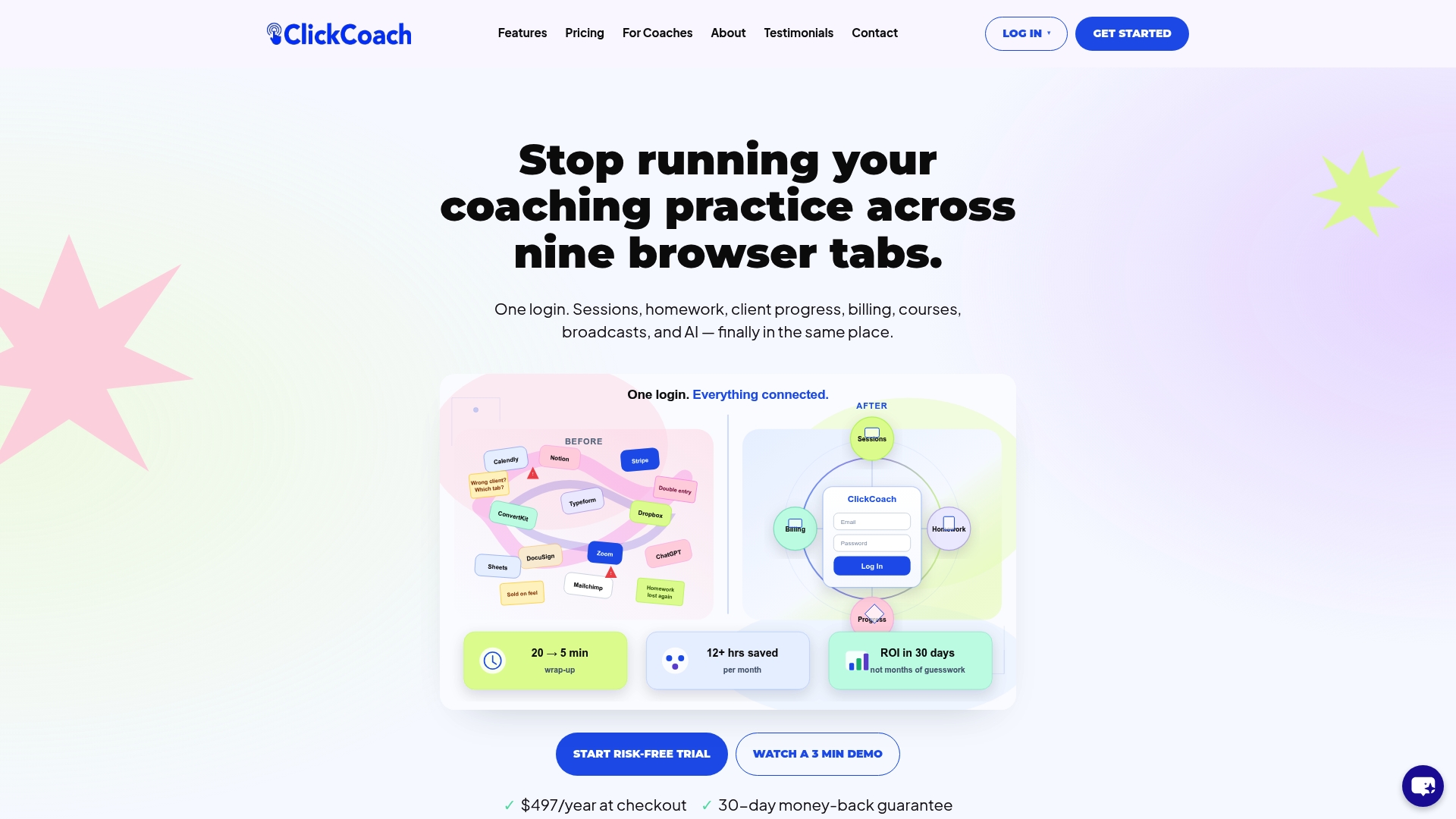
ClickCoach is built for exactly this kind of practice. Every client’s goals, progress data, session history, and homework assignments live under one login, so tracking never falls through the cracks between sessions. If you want to run a more focused, evidence-informed practice without the administrative drag, explore ClickCoach and see how it fits your workflow.