

Hybrid team coaching delivery is a deliberately designed, tech-enabled approach to team development that creates equitable coaching experiences when members split time between office and remote locations. The industry term for the most effective version of this is Systemic Team Coaching, which examines collective patterns rather than individual behavior. Here is your TL;DR:
- Equalize attention in every session: call on remote participants first, mirror their screen presence, and rotate facilitation roles.
- Document every decision in a shared log so remote members have equal access to the “why” behind choices.
- Set a consistent cadence: 60–90 minute bi-weekly team sessions plus weekly 10-minute 1:1 check-ins keep alignment without overloading the calendar.
Teams that adopt these three moves consistently report clearer roles, stronger inclusion, and measurable progress against coaching goals. The rest of this guide shows you exactly how to build that system.
Table of Contents
- What is hybrid team coaching delivery, and how does it differ from remote or in-person?
- The core problem: why hybrid teams break down without deliberate coaching
- How to read the virtual room when physical cues disappear
- How to design hybrid sessions that actually include everyone
- What cadence and session length actually work for hybrid teams
- Which tools and templates keep hybrid coaching on track?
- How do you measure the impact of hybrid team coaching?
- A research-backed framework coaches can use end-to-end
- Key Takeaways
- What most coaches get wrong about hybrid team work
- How ClickCoach helps you deliver hybrid coaching without the administrative drag
- Useful sources for further reading
What is hybrid team coaching delivery, and how does it differ from remote or in-person?
Hybrid team coaching focuses on improving collective performance and cohesion when members are split between office and remote settings. That is a fundamentally different design challenge from either fully remote or fully in-person coaching, and the differences show up in three places: presence, cues, and interaction rhythm.

| Dimension | In-person | Fully remote | Hybrid |
|---|---|---|---|
| Presence | Shared physical space | Equal virtual presence | Unequal: some in-room, some on screen |
| Reading cues | Body language, eye contact | Camera, chat, mute patterns | Mixed: physical for some, virtual for others |
| Interaction rhythm | Organic turn-taking | Structured turn-taking | Requires explicit facilitation to prevent in-room dominance |
| Documentation need | Low (shared context) | Medium | High: remote members miss informal hallway context |
| Equity risk | Low | Low | High without deliberate design |
What does not change across formats is the coaching foundation: psychological safety, structured reflection, and a clear outcome focus remain constant. The coach’s job is still to surface patterns, build self-awareness, and move the team toward shared goals.
What does change is the delivery architecture. In hybrid settings, coaches must design for:
- Attention equity: who gets spoken to, in what order, and how often
- Channel discipline: which conversations happen in which medium, and why
- Documentation: moving ephemeral in-room conversations into persistent shared systems
- Session choreography: explicit facilitation moves that prevent the room from becoming the default focal point
Hybrid coaching combines the best of in-person and online formats while requiring more intentional design than either one alone.
The core problem: why hybrid teams break down without deliberate coaching
The most common failure mode in hybrid team coaching is the in-room sub-dynamic. When three or four co-located members sit together, they naturally create a conversational focal point. Eye contact flows between them. Side comments get made. Energy builds in the room. Remote participants watch this happen on a small tile in the corner of their screen and gradually disengage.
This is not a personality problem. It is a structural one. Hybrid coaching must explicitly manage the structural inequity the in-room sub-dynamic creates, replacing ambiguity with clear roles, responsibilities, and operating rhythms.
Beyond the focal-point dynamic, hybrid teams face three other structural inequities:
- Informal context access: co-located members absorb decisions made in hallways, at lunch, or before the meeting starts. Remote members miss all of it.
- Proximity bias: managers and peers unconsciously favor those they see in person for development opportunities, stretch assignments, and recognition.
- Uneven visibility: remote members are less likely to be seen as “present” contributors, which affects performance perception over time.
Diagnostic checklist: run this before or during a session
- [ ] Are remote participants speaking for a proportional share of the session time?
- [ ] Do in-room members turn toward the screen when addressing remote colleagues, or toward each other?
- [ ] Are decisions being made in the room before or after the session, without remote input?
- [ ] Does the meeting summary capture context that was only spoken aloud in the room?
- [ ] Are remote members included in informal pre-session conversation, or does it start without them?
Pro Tip: When you notice the room pulling focus, pause the session and physically reframe it. Ask everyone in the room to turn their chairs to face the screen. It sounds simple, but it immediately signals that the remote participants are the primary audience, not an afterthought.
How to read the virtual room when physical cues disappear
In a fully in-person session, you read the room through posture, eye contact, and energy. In hybrid delivery, you read it through a different set of signals. Transitioning from body language to virtual participation patterns is one of the most practical shifts a coach can make.
Watch for these observable patterns:
- Camera behavior: a participant who was on camera and suddenly turns it off mid-session is often disengaging or uncomfortable. Note the trigger.
- Mute patterns: someone who stays muted even during open discussion may be self-censoring or feeling excluded.
- Chat signals: side conversations in chat between two remote members during a plenary discussion often signal disagreement or confusion they are not voicing aloud.
- Reaction emojis and polls: low response rates to a poll or reaction prompt are a reliable indicator of low psychological safety or disengagement.
- Speaking time distribution: if two or three participants are generating 80% of the verbal output, the team’s collective intelligence is being underused.
Knowing when to probe versus when to let silence sit is a judgment call. A brief silence after a reflective question is productive. A silence that follows a moment of visible discomfort (camera off, chat spike, sudden mute) usually warrants a gentle, direct check-in.
That kind of intervention only happens when the coach is actively monitoring virtual participation signals, not just managing the agenda.

How to design hybrid sessions that actually include everyone
The single most effective thing you can do for hybrid team equity is to design the session before it starts, not improvise inclusion in the moment.
Sample 90-minute hybrid team coaching session
- Pre-session check (5 min, async): send a one-question pulse prompt 24 hours before. “What’s one thing you want the team to address today?” Collect responses in a shared doc.
- Connection ritual (10 min): structured check-in with every participant, remote first. One word or one sentence. No exceptions.
- Agenda review and context share (5 min): the coach reads the pulse responses aloud so everyone hears the same framing.
- Core work block (45–55 min): structured discussion with explicit turn-taking. Use breakout rooms (remote + in-room mixed) for sub-group work.
- Decision and commitment capture (10 min): the coach or a rotating scribe logs every decision and owner in the shared decision log, visible to all.
- Closing ritual (5–10 min): one-word close from each participant, remote first. Coach summarizes the session’s key shift in one sentence.
Facilitation moves that level the playing field
- Call on remote participants first before opening discussion to the room. This prevents in-room members from setting the conversational frame.
- Use equal-layout video settings (gallery view) so no participant’s tile is visually dominant.
- Assign a “remote advocate” role to an in-room participant who monitors the chat and flags when remote members are trying to speak.
- Design breakouts with mixed groups: never put all remote participants in one breakout and all in-room participants in another.
- Name the norm explicitly: at the start of every session, state that remote participants speak first in each round.
Pro Tip: Side conversations in the room are the single biggest equity killer in hybrid sessions. When you hear whispering or see two in-room participants leaning toward each other, name it directly: “Let’s bring that into the room for everyone.” You only need to do it twice before the team self-corrects.
Pro Tip: Build a two-minute “tech check” into the opening ritual. Ask every remote participant to confirm audio and video quality before the substantive work begins. It prevents the first 10 minutes of real discussion from being derailed by a muted microphone.
What cadence and session length actually work for hybrid teams
Industry guidance consistently recommends 60–90 minute sessions for hybrid team coaching. Shorter sessions do not allow enough time for the equalization rituals, the core work, and the documentation close. Longer sessions push remote participants into fatigue faster than in-room ones, widening the equity gap.
For overall program cadence, a three-tier rhythm works well:
- Weekly 10-minute 1:1 check-ins between the coach (or team leader) and each team member, structured around Wins, Challenges, Priorities, and Support needed
- Bi-weekly 60–90 minute team coaching sessions for collective reflection, decision-making, and pattern work
- Monthly 90-minute deep sessions for strategic review, framework updates, and stakeholder reporting
This approach shifts accountability from proximity to clarity, coaching rhythms, and documented decisions, which is exactly what hybrid teams need.
Sample 12-week hybrid coaching rhythm
| Week | Format | Focus |
|---|---|---|
| 1 | 90-min team session | Kickoff, norms, decision log setup |
| 2 | 10-min 1:1s | Individual alignment check |
| 3 | 60-min team session | First pattern review |
| 4 | 10-min 1:1s + async pulse | Mid-cycle check-in |
| 5–6 | 90-min team session | Deep work block + stakeholder prep |
| — | 10-min 1:1s | Accountability review |
| — | 60-min team session | Decision audit |
| 60–90 | Async reflection + 10-min 1:1s | Individual progress review |
| — | 90-min team session | Framework refinement |
| 12 | 90-min team session | Outcomes review + next cycle planning |
When time zones span more than three hours, shift the monthly deep session to a rotating time slot so no single location always carries the inconvenience of an early or late call. Async pre-reads and recorded reflections can replace up to 20% of synchronous time without losing depth.
Which tools and templates keep hybrid coaching on track?
The right tools for hybrid coaching delivery are not the flashiest ones. They are the ones your client team will actually use consistently. Documentation is a core delivery pillar because it preserves the context that in-person conversations carry naturally.
Tool categories to prioritize:
- Shared decision logs: a simple table (Google Sheets, Notion, or a client portal) where every decision, owner, and deadline is recorded after each session
- Collaborative meeting notes: a live document open during the session so remote participants can contribute in real time
- Async video tools (Loom is widely used): for pre-session context-setting or post-session reflections that do not require a live call
- Scheduling and time zone aids (World Time Buddy, Calendly with time zone detection): to prevent the recurring friction of cross-location scheduling
- Lightweight polling (built into Zoom, Microsoft Teams, or standalone tools like Mentimeter): for real-time pulse checks during sessions
Copyable templates
Meeting summary template (end of every session):
Date:
Attendees (in-room / remote):
Key decisions made:
  - Decision | Owner | Deadline
Open questions:
Next session date and pre-work:
Decision log row:
| Date | Decision | Context | Owner | Deadline | Status |
10-minute 1:1 script (Wins / Challenges / Priorities / Support):
1. What's one win since we last spoke? (2 min)
2. What's one challenge you're navigating? (2 min)
3. What are your top priorities this week? (3 min)
4. What support do you need from me or the team? (3 min)
Implementation checklist for introducing tools to a client team
- Pilot with one tool first: introduce the decision log before adding async video or polling.
- Set naming conventions: agree on file names, folder structure, and channel labels before the first session.
- Establish channel rules: which conversations go in email, which in the team channel, which in the shared doc.
- Run an adoption checkpoint at week 4: review whether the decision log is being updated and whether remote members are accessing it.
- Prioritize searchable history and shareable client portals: these two features matter most for long-term equity. A decision made in week 2 should be findable in week 10.
For coaches managing multiple hybrid team engagements, a platform with built-in session templates and persistent client portals removes the overhead of rebuilding these systems for each new client.
How do you measure the impact of hybrid team coaching?
Measurement in hybrid coaching serves two purposes: it tells you whether the team is actually improving, and it gives you evidence to present to the stakeholders who commissioned the engagement.
Suggested KPIs:
- Participation parity: percentage of session speaking time distributed across all members (remote and in-room combined)
- Decision completion rate: percentage of logged decisions completed by their stated deadline
- Cycle time to decisions: average time from issue raised to decision documented
- Perceived inclusion score: a simple 1–5 rating collected after each session (“I felt equally heard in today’s session”)
- Outcome achievement rate: percentage of coaching goals marked complete at the end of each cycle
Sample pulse questions (ask after each session or weekly):
- “On a scale of 1–5, how equally heard did you feel today, regardless of your location?”
- “What is one thing the team did well in today’s session that you’d like to see repeated?”
Combine these quantitative signals with qualitative indicators: leadership observations, anecdotal improvements in decision speed, and changes in how team members describe their working relationships. Neither type of evidence alone tells the full story.
For stakeholder reporting, a simple one-page summary works well:
- Trend line: participation parity score over the program weeks
- Decision log audit: completion rate and average cycle time
- Qualitative highlights: two or three direct observations from sessions
- Next cycle focus: one or two patterns the team is still working through
Present this monthly, not just at program end. Stakeholders who see progress in real time are far more likely to extend or expand the engagement.
A research-backed framework coaches can use end-to-end
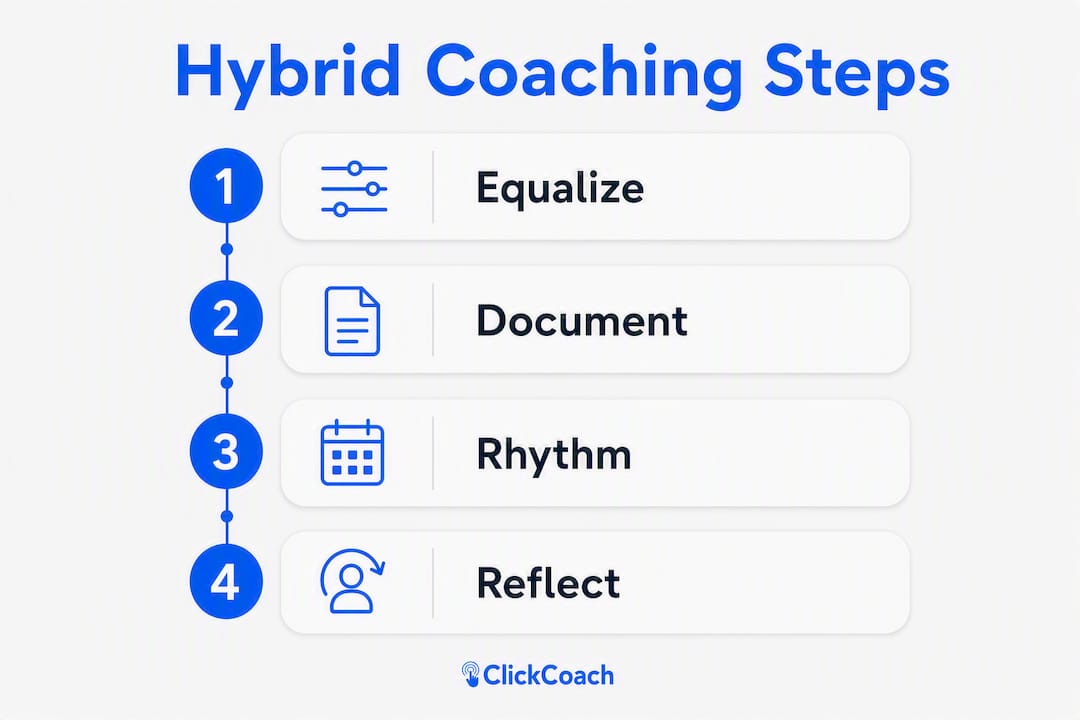
The most practical framework for hybrid team coaching delivery maps to four steps: Equalize, Document, Rhythm, Reflect. Each step connects directly to the evidence base.
Step 1: Equalize Design every session so remote and in-room participants have equivalent access to voice, information, and decision-making. Call on remote participants first. Use equal-layout video. Assign a remote advocate. Effective hybrid leaders design communication systems that protect equity and audit culture regularly.
Step 2: Document Move every decision, commitment, and key context point into a persistent shared system immediately after (or during) each session. Coaches should guide teams to move ephemeral conversations into persistent shared systems so remote members have equal access to context. Use the decision log template above.
Step 3: Rhythm Set a consistent cadence and protect it. Weekly 10-minute 1:1s, bi-weekly team sessions, monthly deep reviews. Hybrid coaching programs use weekly or bi-weekly touchpoints and standardized tools to keep all members aligned regardless of location.
Step 4: Reflect Build structured reflection into every session close and every monthly review. Team coaching examines how people work together to improve collective dynamics, which is especially relevant for hybrid teams where friction hides behind the logistics of distribution.
For teams of 10 or fewer, all four steps fit within the 12-week rhythm above. For larger teams (15+), add a fifth step: Segment, breaking the team into sub-groups for the bi-weekly sessions and bringing the full team together only for the monthly deep session. For teams spanning more than three time zones, replace one synchronous session per month with an async reflection cycle using recorded video and a shared response doc.
For coaches who want to go deeper on executive coaching frameworks that underpin this kind of systemic work, the structural principles translate directly to hybrid team contexts.
Key Takeaways
Hybrid team coaching delivery works when coaches equalize participation, document every decision, and hold a consistent cadence across all locations.
| Point | Details |
|---|---|
| Equalize before you facilitate | Call on remote participants first in every round to prevent in-room members from setting the conversational frame. |
| Document decisions immediately | Use a shared decision log after every session so remote members retain equal access to context and commitments. |
| Hold a three-tier cadence | Weekly 10-min 1:1s, bi-weekly 60–90 min team sessions, and monthly deep reviews keep alignment without overloading the calendar. |
| Measure participation parity first | Track speaking-time distribution and perceived inclusion scores before adding more complex KPIs. |
| ClickCoach supports the full system | ClickCoach’s session templates, persistent client portals, and progress tracking reduce the administrative overhead of running hybrid coaching at scale. |
What most coaches get wrong about hybrid team work
The conventional wisdom says hybrid coaching is just remote coaching with some people in a room. That framing leads coaches to under-design the in-person side and over-rely on the tools they already use for fully virtual work.
The real challenge is not the technology. It is the social architecture. When a group of co-located colleagues shares a room, they form a micro-culture in real time: shared glances, inside references, the energy of physical proximity. Remote participants are not just “dialing in from home.” They are watching a social event they cannot fully join. A coach who does not actively disrupt that dynamic will find that the team’s most important conversations happen before or after the session, not during it.
Hybrid work changes how context surfaces, and coaches who treat it as an administrative policy rather than a communication-architecture shift will consistently underdeliver. The fix is not a better video platform. It is a deliberate decision to over-communicate the “why” behind every decision, to name the norms out loud at the start of every session, and to make documentation a coaching deliverable, not an afterthought.
The coaches who get this right share one habit: they treat the session design as part of the coaching intervention itself. The agenda, the turn-taking protocol, the decision log, the closing ritual — these are not logistics. They are the conditions that make psychological safety possible for people who are not in the room.
For coaches building executive coaching best practices into their hybrid delivery, the structural discipline described here transfers directly to leadership development contexts.
How ClickCoach helps you deliver hybrid coaching without the administrative drag
Running hybrid team coaching well requires a lot of moving parts: session templates, decision logs, pulse surveys, client portals, and progress tracking across multiple engagements. Keeping all of that organized across separate apps is where most coaches lose time and consistency.
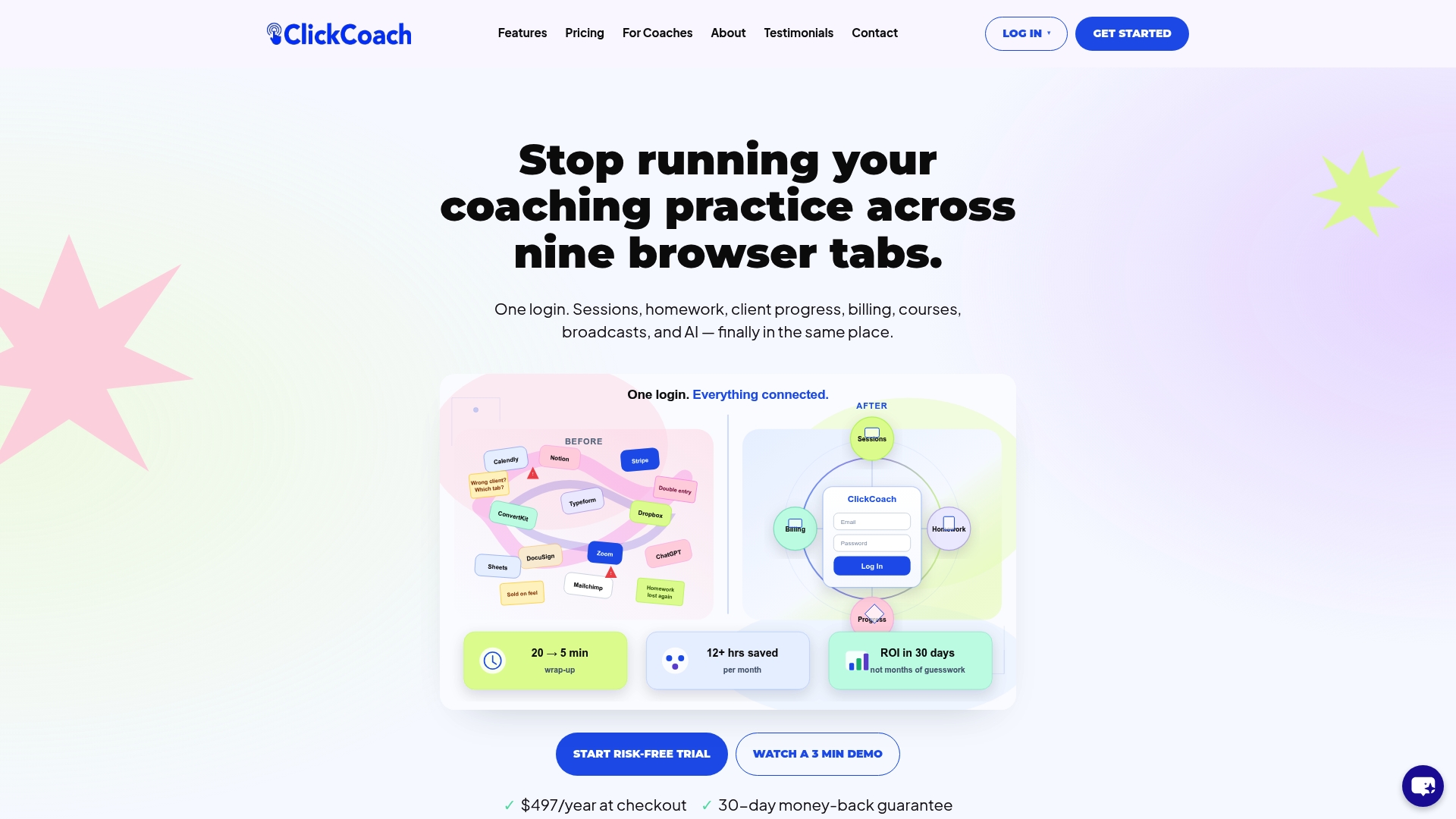
ClickCoach brings the full system under one login. You can build reusable session templates for your hybrid coaching agenda, store decision logs and meeting summaries in searchable client portals, and track each team member’s progress over time without rebuilding your system for every new engagement. The platform’s AI assists with drafting session homework and reflection prompts, which means your async touchpoints between live sessions stay consistent and professional. Coaches using ClickCoach report saving up to 20 minutes per session on administrative tasks, time that goes back into the actual coaching work.
If you are ready to run hybrid team coaching with less friction and more measurable outcomes, explore ClickCoach and start a 30-day trial today.
Useful sources for further reading
-
Team Coaching for Remote & Hybrid Teams — TandemCoach: Practitioner-focused analysis of the in-room sub-dynamic and structural inequity in hybrid settings. One of the clearest explanations of why hybrid coaching requires explicit design.
-
Leading Hybrid Teams: The Management Playbook — ICPM: Covers the shift from proximity-based management to clarity-based leadership, with practical frameworks for 1:1 cadence, decision documentation, and accountability systems.
-
How Managers Can Keep Hybrid Teams Connected and Resilient — Psychology Today: Research-informed perspective on communication architecture and why over-communicating context is a leadership discipline, not a nice-to-have.
-
Hybrid Leadership Coaching: Building Culture When Teams Are Everywhere — KKM Leadership: Practical guidance on designing rituals, auditing culture, and protecting the moments that build trust across locations.
-
How Team Coaching Supports Leaders of Remote & Hybrid Teams — Canada Coach Academy: Explains the shift from individual-focused coaching to Systemic Team Coaching and why it matters for distributed teams.
-
The Challenge of Coaching Hybrid Teams — UW–Madison Center for Professional & Executive Development: University-backed perspective on the specific challenges leaders face when coaching hybrid teams, grounded in professional development research.
-
How to Level Up Your Coaching Practice with Hybrid Coaching — MemberPress: Practical adoption guidance for coaches building hybrid delivery into their practice, including design principles for scalability and equity.