

Client self-reflection in coaching is the intentional, structured process by which a client examines their own thoughts, feelings, and actions to generate insight that leads to measurable change. It is not casual introspection. It is a disciplined practice the coach facilitates, and it sits at the center of every meaningful coaching outcome.
Three reasons it matters immediately:
- Self-awareness: Clients surface limiting beliefs and blind spots they cannot see without structured examination.
- Action-readiness: Reflection converts vague dissatisfaction into clear, concrete next steps.
- Accountability: When clients articulate their own insights, they own the commitment to act on them.
Table of Contents
- Why client self-reflection produces real coaching outcomes
- How do you actually elicit reflection during a session?
- Which models and tools structure reflective work best?
- How do you assess a client’s reflective capacity?
- What are the pitfalls and ethical limits of reflection work?
- Concrete homework exercises that build reflective competence
- How do you convert reflective insight into measurable change?
- Key Takeaways
- The part most coaches underestimate
- ClickCoach makes reflective homework easier to assign and track
Why client self-reflection produces real coaching outcomes
The benefits of coaching self-reflection are well-documented: heightened self-awareness, stronger emotional intelligence, clearer decision-making, and a tighter link between insight and real-world behavior. A client who reflects deeply does not just understand what they want. They understand why they have been avoiding it.
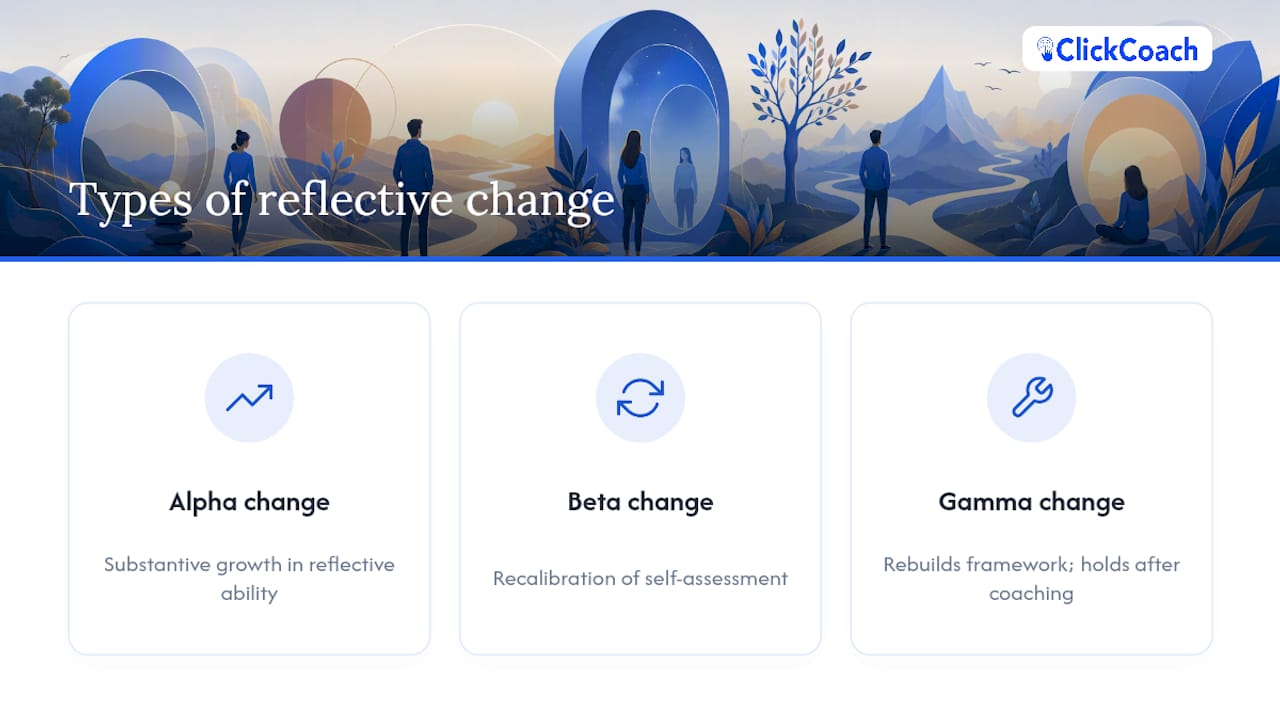
A 2024 within-person study of 61 coachees identified three distinct types of reflective change after coaching: alpha change (substantive growth in reflective ability), beta change (recalibration of how clients measure their own reflection), and gamma change (a full re-conceptualization of what reflection means to them). That taxonomy matters practically. A client who shifts at the gamma level does not just reflect better. They rebuild their entire framework for self-assessment, which is the kind of change that holds after coaching ends.
Consider a leadership client who enters coaching believing their team’s poor performance is a communication problem. Through structured reflection, they discover the real pattern: they avoid conflict, which creates ambiguity, which produces underperformance. That reframe is a gamma-level shift. It changes behavior across every relationship, not just one team.
Research also links reflection, awareness, and self-regulation to improved decision-making and problem-solving, and frames these as learnable skills, not fixed traits. That means every client you work with can develop greater reflective capacity, given the right scaffolding.
How do you actually elicit reflection during a session?
The most reliable method combines powerful questioning with active listening. Neither works alone. A sharp question asked while you are mentally composing the next question produces surface reporting, not genuine processing.
A proven questioning sequence follows three steps:
- Rephrase the client’s statement back to them in slightly different language (“So what you’re describing is a pattern, not a one-time event?”).
- Hypothetical relocating: shift their perspective to a different context or vantage point (“If a trusted colleague were watching this situation from the outside, what would they notice?”).
- Targeted question: ask the reflection-generating question now that perspective has shifted (“What does that tell you about what you actually want here?”).
This sequence works because it moves the client out of their default narrative before asking them to evaluate it.
What to do:
- Hold silence after a question. Pauses are processing, not awkwardness.
- Notice when a client slows down, self-corrects, or uses phrases like “actually, I think…” — these are markers of genuine reflective processing.
- Reflect nonverbal cues back gently (“You paused there. What came up?”).
What to avoid:
- Leading questions that embed your hypothesis (“Don’t you think the real issue is…?”).
- Fixing mode: offering solutions before the client has fully examined the problem.
- Rushing through silence to fill the space.
Pro Tip: Watch for epistemic markers — phrases like “I hadn’t thought of it that way” or “Wait, that’s interesting” — as signals that a client has entered genuine reflective processing. That is the moment to slow down, not speed up.
Which models and tools structure reflective work best?
Three frameworks give coaches a practical architecture for reflective work.
The Reflective Practice Model (reflection → awareness → self-regulation) offers an integrated framework for converting insight into behavior change. Use it to structure both in-session debrief and between-session homework. The model’s strength is its linearity: clients can see exactly where they are in the process.
What–So What–Now What (developed from Borton’s framework, refined by Rolfe et al.) works well for post-event reflection. What happened? So what does it mean? Now what will you do differently? It is fast, memorable, and easy to assign as written homework.
Dewey and Schön’s reflective practice tradition underpins both models. Dewey’s “reflective thinking” and Schön’s “reflection-in-action” remind coaches that the goal is not just post-hoc analysis but developing a client’s capacity to reflect while acting.
Three session-ready journaling prompts:
- “Describe a moment this week when you reacted differently than you expected. What was driving that reaction?”
- “What assumption did you make today that turned out to be wrong? What does that reveal?”
- “Where did you hold back? What would you have done if you were not afraid of the outcome?”
A compact 3-step reflective debrief template:
- Ask the client to name one moment from the past week that felt significant (positive or negative).
- Walk through What–So What–Now What together, with the coach listening and reflecting rather than interpreting.
- Close with one concrete commitment: “Based on what you just said, what is one thing you will do differently before we meet again?”
How do you assess a client’s reflective capacity?
Clients vary widely in their natural reflective ability. Some can only reflect at the level of actions initially. Pushing them toward emotional or belief-level reflection too early produces frustration, not insight. Self-reflective competence often begins before coaching and evolves during and after it, so your assessment informs where to start, not where the client will end up.
Behavioral indicators of reflective depth:
- Superficial: Describes events without interpretation. Uses “they” and “it” more than “I.” Rarely pauses. Deflects emotional questions with logistics.
- Moderate: Connects events to feelings. Occasionally self-corrects. Willing to consider alternative perspectives when prompted.
- Deep: Spontaneously questions their own assumptions. Uses nuanced emotional language. Notices patterns across contexts. Generates their own hypotheses.
A practical assessment prompt: Ask the client to describe a recent situation where something did not go as planned. Listen for whether they explain what happened, why it happened (their interpretation), and what it means about them or their patterns. That three-layer response is a reliable indicator of reflective depth.
Tailored approaches by level:
- Low reflective capacity: Start with action-based reflection (“What did you do? What happened next?”). Introduce the “why” layer only after trust is established.
- Moderate: Use the What–So What–Now What model. Assign short written prompts between sessions.
- High: Use hypothetical relocating and deeper belief-level questions. Assign critical-incident reviews and encourage self-reflection techniques that build on existing capacity.
What are the pitfalls and ethical limits of reflection work?
Unstructured reflection is not neutral. Without criteria and scaffolding, it slides into rumination, self-deception, or, in clients with trauma histories, retraumatization.
Red flags to watch for:
- The client returns to the same painful memory repeatedly without generating new meaning.
- Reflection produces shame spirals rather than curiosity.
- The client becomes more avoidant or distressed after reflective exercises, not less.
- Dissociative responses: flat affect, disconnection from the narrative, difficulty staying present.
Mitigation strategies:
- Set explicit criteria before assigning reflection: “We’re looking for patterns, not verdicts.”
- Time-box reflection exercises (10–20 minutes maximum for written homework).
- Use supervision to check your own blind spots when a client’s reflection triggers your own material.
- When distress is clinical in nature, pause reflective work and refer to a licensed mental health professional. Coaching is not therapy, and that boundary protects the client.
Concrete homework exercises that build reflective competence
Reflective techniques with documented benefits include journaling, critical-incident review, and brief written exercises. Here are three ready-to-assign templates:
- Daily reflection journal (10 minutes/day): — At the end of each day, write three sentences: what happened, what you felt, and what you would do differently. No editing, no judgment.
Sample message coaches can send when assigning homework:
Tracking and integration: At the start of the next session, ask the client to read one entry aloud. Then ask: “What surprised you?” That single question integrates the homework without turning the session into a review.
How do you convert reflective insight into measurable change?
Insight without action is just interesting. The goal is a repeatable conversion process:
- Name the insight in the client’s own words (“I avoid conflict because I equate it with rejection”).
- Translate to a concrete behavior (“I will address disagreements in the moment rather than waiting”).
- Set a SMART goal (“I will initiate one direct conversation about a disagreement each week for the next four weeks”).
- Define a success metric (“I will rate my discomfort level before and after each conversation on a 1–10 scale and track whether it decreases over time”).
Progress metrics that work:
- Frequency counts (“How many times did you use the new behavior this week?”).
- Self-rated confidence or discomfort scores before and after target situations.
- Qualitative markers: “What did you notice about how others responded differently?”
Realistic timelines: behavioral shifts tied to a single insight typically become consistent within four to six weeks of deliberate practice. Belief-level changes take longer and often require revisiting the original insight as new evidence accumulates. Review progress every two to three sessions and adjust the goal if the metric reveals the behavior is already habitual or still out of reach.
Learning how to hold a coaching conversation that moves fluidly from reflection to commitment is itself a skill coaches develop over time.
Key Takeaways
Client self-reflection is the structured, coach-facilitated process that converts a client’s raw experience into insight, and insight into lasting behavioral change.
| Point | Details |
|---|---|
| Core definition | Self-reflection is intentional, structured examination of thoughts, feelings, and actions, not casual introspection. |
| Three types of change | A 2024 study of 61 coachees found alpha, beta, and gamma reflective changes, each with different depth and durability. |
| Best elicitation method | Rephrase, hypothetical relocating, and targeted questioning reliably prompt perspective shifts when paired with active listening. |
| Pitfall to avoid | Unstructured reflection becomes rumination; always provide criteria, time limits, and a clear purpose. |
| ClickCoach for tracking | ClickCoach lets coaches assign homework, track client progress, and review reflective artifacts all in one place. |
The part most coaches underestimate
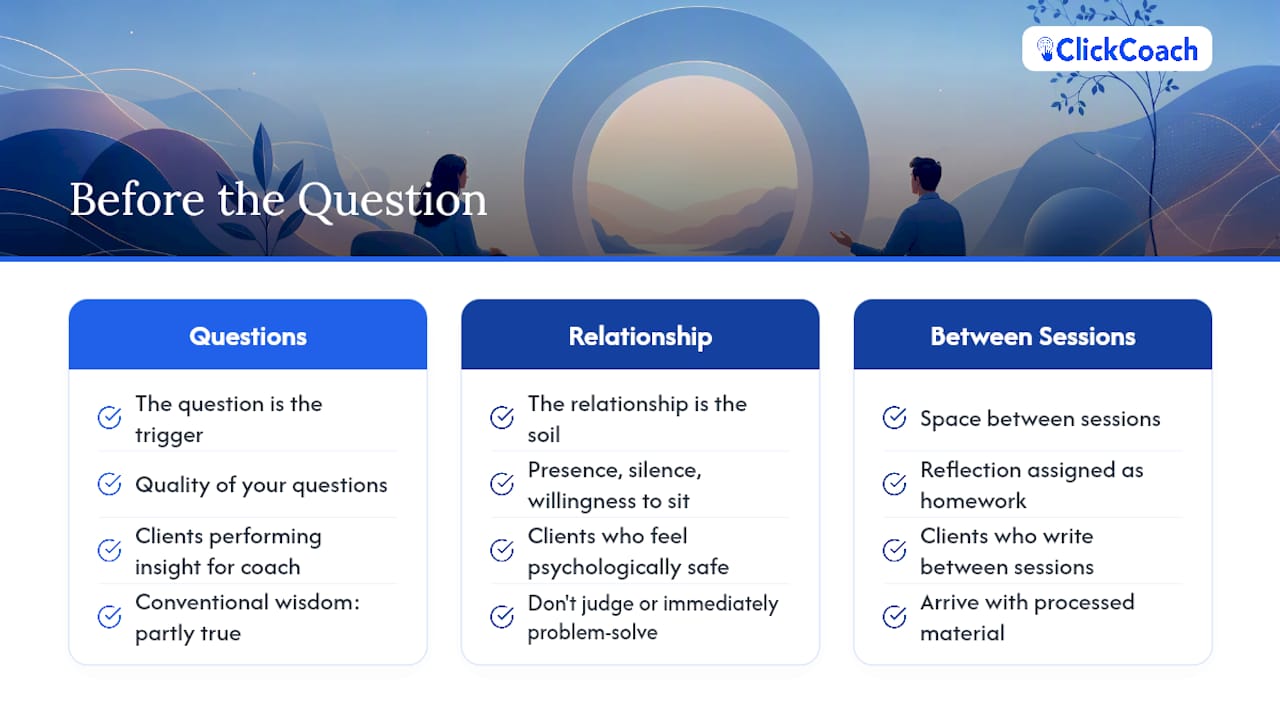
The conventional wisdom says the quality of your questions determines the quality of reflection. That is partly true. But the bigger variable is what you do before the question. Clients who feel psychologically safe, who trust that their honest answer will not be judged or immediately problem-solved, reflect at a qualitatively different level than clients who are performing insight for an attentive coach.
The implication is practical: your presence, your silence, and your willingness to sit with a client’s uncertainty without rushing to resolve it are the actual conditions for deep reflection. The question is the trigger. The relationship is the soil.
There is also a structural gap most coaches leave unaddressed: the space between sessions. Reflection assigned as homework and reviewed at the next session creates a continuity of self-examination that in-session work alone cannot produce. Clients who write between sessions arrive with processed material, not raw events. That shifts the entire session dynamic.
ClickCoach makes reflective homework easier to assign and track
Coaches who take reflective work seriously quickly run into a practical problem: keeping track of what was assigned, what the client actually submitted, and how responses connect to session goals across weeks or months. Spreadsheets and email threads do not scale.

ClickCoach gives you a single place to assign structured homework, store client responses, and review progress before each session. The platform’s AI helps you draft reflection prompts tailored to each client’s current goals, and the client portal makes submission straightforward enough that clients actually do it. You can tie homework directly to session notes and track behavioral metrics over time, so the insight-to-action conversion has a visible record. No more reconstructing what was agreed three sessions ago.
If you want a practice where reflective work produces results you can actually see, start with ClickCoach and see how much cleaner the whole process becomes.