

Recurring assessments in coaching are defined as structured, repeated data-collection tools that measure client progress between and during sessions. The role of recurring assessments in coaching goes beyond simple check-ins. They create a continuous feedback loop that drives behavioral change, keeps clients accountable, and gives coaches the real-time data they need to make every session count. The International Coaching Federation identifies ongoing client monitoring as a core competency, and research confirms that coaches who measure consistently outperform those who rely on memory and intuition alone. If you want to build a practice where clients stay longer and grow faster, structured recurring evaluations are the backbone of that method.
What is the role of recurring assessments in coaching?
Recurring assessments are the primary mechanism through which coaches track behavioral change over time. A single pre-session intake tells you where a client starts. Ongoing performance assessments tell you whether they are actually moving, stalling, or regressing. That distinction changes everything about how you coach.
The most important function of recurring assessments is that they shift coaching conversations from status updates to strategic decisions. When a client walks in and you already have four weeks of data on their confidence levels, goal completion, and energy patterns, you skip the “so how was your week?” phase entirely. You go straight to what the data reveals.

Corporate clients treat assessment data as ROI signals, not just development tools. That framing matters for every coach, not just those in executive settings. When you can show a client a visible trend line, you make the value of coaching concrete and measurable. That visibility builds trust and justifies continued investment.
Recurring assessments also create a shared language between coach and client. Anchoring conversations in data reduces subjective bias and keeps sessions focused on what actually matters. Without that anchor, sessions drift toward whatever feels urgent that week rather than what drives long-term growth.
How often should recurring assessments be administered?
Frequency is the most common question coaches ask, and the answer is more specific than most expect. A minimalist structure of 5–8 weekly questions combined with a monthly comprehensive review produces the best balance of data quality and client completion rates. Weekly questions keep the feedback loop active. Monthly reviews analyze four-week blocks for meaningful trends.
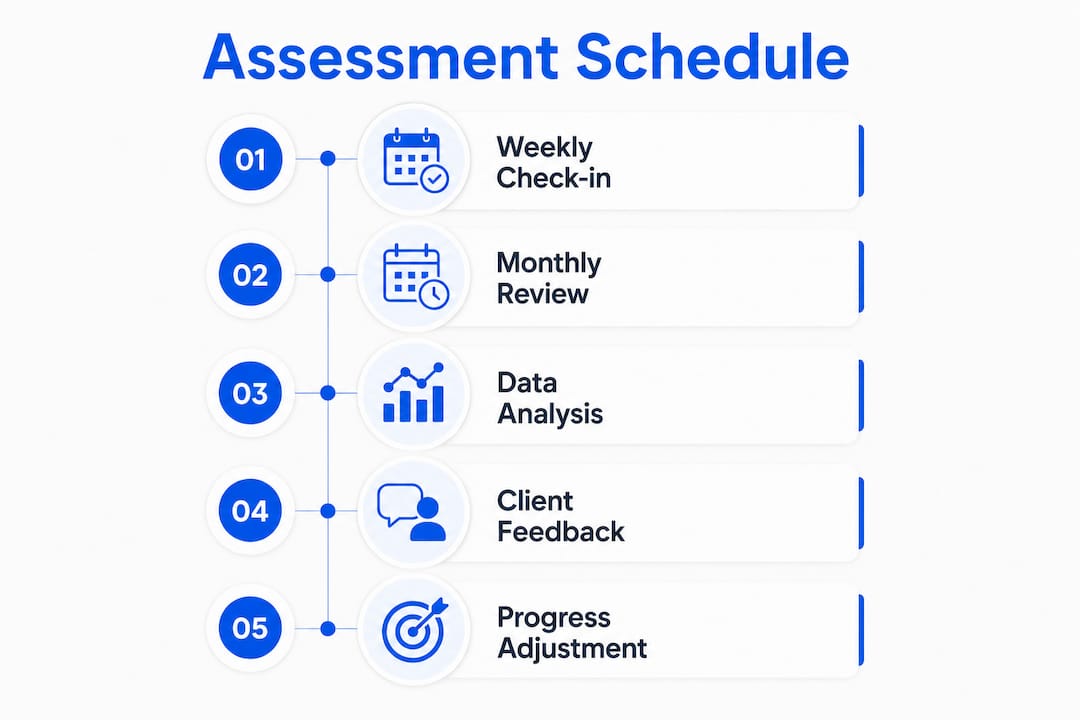
The risk of going too frequent is real. Daily assessments create fatigue and lower completion rates, which means your data becomes unreliable. The risk of going too infrequent is equally damaging. Monthly-only check-ins miss the week-to-week fluctuations that reveal how a client actually behaves under pressure.
Here is a practical scheduling framework that works across most coaching contexts:
- Weekly micro-check-ins: 5–8 questions covering goal progress, energy, and one key behavior. Takes the client under three minutes to complete.
- Monthly deep reviews: A 15–20 question assessment covering mindset shifts, obstacle patterns, and goal alignment. Reviewed together in session.
- Quarterly progress audits: A full retrospective comparing current scores to baseline. Used to reset goals and celebrate measurable wins.
- Ad-hoc pulse checks: A 2–3 question check-in triggered by a missed session, a major life event, or a client-reported setback.
Pro Tip: Set up your weekly check-in to arrive in the client’s inbox 24 hours before each session. They arrive prepared, and you arrive with data. That combination cuts session warm-up time significantly.
The key principle is consistency over volume. A client who completes a five-question check-in every week for six months gives you far more usable data than one who completes a 30-question assessment twice a year.
What are the key benefits of recurring assessments for client engagement?
The most direct benefit of recurring evaluations is reduced dropout. Clients who complete between-session assessments show lower dropout rates and better goal attainment because the assessment itself maintains connection between sessions. The act of answering questions keeps the coaching relationship active even when you are not in the room.
This is a point most coaches underestimate. The assessment is not just a data-collection tool. It is a therapeutic intervention. Between-session assessments prompt reflection and structure self-awareness in ways that a single weekly session cannot replicate. A client who spends three minutes answering focused questions on a Wednesday afternoon is doing real developmental work, not just filling out a form.
The numbered benefits below represent what coaches consistently report once they build recurring evaluations into their practice:
- Higher session quality. You enter each session with context. The client enters with clarity. Both of you spend less time catching up and more time moving forward.
- Stronger client accountability. Completing a check-in is a small commitment. Keeping that commitment weekly builds the habit of follow-through that transfers to bigger goals.
- Visible progress that motivates. Clients who can see their own trend data report higher confidence and greater ownership of their results.
- Earlier detection of disengagement. A drop in completion rates signals a problem before the client cancels. You can intervene while there is still time.
- Data-backed coaching decisions. You adjust your approach based on evidence, not gut feel. That makes your coaching more precise and your client outcomes more predictable.
“The coaching session is where insight happens. The assessment is where that insight gets tested against real life. Without both, you are only coaching half the process.”
Leadership clients who review assessment data multiple times during an engagement show significantly greater behavioral progress than those who treat assessments as one-time exercises. The review frequency matters as much as the assessment frequency. Collecting data without reviewing it together is the most common mistake coaches make.
How can coaches interpret recurring assessment data effectively?
Raw assessment scores are less useful than the patterns they reveal over time. Longitudinal session-by-session measurement uncovers developmental trajectories that a simple pre-and-post comparison completely misses. You see consolidation dips, regression events, and the gradual narrowing of variance that signals genuine progress.
That last point deserves attention. True developmental progress shows up as tightening variance, meaning the gap between a client’s best and worst weeks gets smaller. A client who scores 4 out of 10 one week and 9 out of 10 the next is not progressing. A client who consistently scores 7–8 out of 10 has internalized the behavior. Variance narrowing is measurable only through session-by-session data, which is exactly why recurring assessments matter more than endpoint snapshots.
The table below shows how to interpret four common data patterns and what each one signals for your coaching approach:
| Pattern | What it signals | Coaching response |
|---|---|---|
| Consistent upward trend | Skill integration is working | Increase challenge level or expand scope |
| Plateau after initial gains | Consolidation phase | Maintain current approach, reduce pressure |
| Sudden regression | External stressor or goal misalignment | Investigate context, adjust commitments |
| Variance narrowing | True behavioral change | Celebrate and document as evidence of progress |
| Missed submissions | Emotional resistance or planning failure | Approach with curiosity, redesign the check-in |
Missed assessments are not failures. Non-compliance is diagnostic data that signals emotional resistance, goal misalignment, or a check-in format that does not fit the client’s life. The right response is curiosity, not pressure. Ask what got in the way, and use the answer to redesign the commitment so it actually fits.
Pro Tip: Track your clients’ assessment completion rates alongside their goal attainment scores. When completion drops, goal attainment almost always follows within two to three weeks. That early warning gives you time to act.
What are best practices for integrating assessments into your coaching workflow?
The biggest barrier to consistent recurring assessments is not client resistance. It is coach complexity. When assessments require manual sending, chasing, and compiling, most coaches abandon the practice within 90 days. The solution is a structured execution layer that runs with minimal manual effort.
A structured execution layer with daily check-ins, weekly reviews, and visible quarterly priorities increases client tenure by 20–30%. That retention improvement alone justifies the setup time. Coaches who build this layer report that it reduces their administrative burden rather than adding to it, because the data replaces the need for lengthy verbal updates.
Here are the core practices that make recurring assessments sustainable for coaches:
- Automate delivery. Use a platform that sends check-ins automatically on a set schedule. Manual sending creates inconsistency and adds work you do not need.
- Co-design the check-in with the client. Clients who select their own tracking methods show better follow-through and less resistance. Give them input on the questions and the format.
- Keep it short. Five focused questions outperform 20 generic ones every time. Respect the client’s time and they will protect the habit.
- Review data before every session. Build a five-minute pre-session data review into your workflow. It changes how you open the conversation and what you prioritize.
- Use a visibility dashboard. A centralized view of all client progress data lets you spot patterns across your entire practice, not just within individual client files.
The coaches who struggle with recurring assessments are usually trying to run them through email threads and spreadsheets. That approach breaks down fast. Purpose-built tools that centralize check-in delivery, response tracking, and progress visualization make the entire system sustainable.
Key Takeaways
Recurring assessments are the most reliable mechanism coaches have for tracking behavioral change, maintaining client engagement, and making every session strategically focused.
| Point | Details |
|---|---|
| Define a clear frequency | Use 5–8 weekly questions plus a monthly deep review to balance data quality and completion rates. |
| Treat completion as a signal | Missed check-ins reveal resistance or misalignment. Respond with curiosity, not pressure. |
| Look for variance narrowing | Tightening scores across weeks indicate true behavioral change, not just good days. |
| Co-design with clients | Clients who choose their own tracking methods show stronger follow-through and longer engagement. |
| Automate the workflow | A structured execution layer reduces coach workload and increases client tenure by 20–30%. |
What I have learned from building assessment systems into coaching practices
I used to think recurring assessments would add hours to my week. That fear kept me from implementing them consistently for longer than I care to admit. The reality turned out to be the opposite.
Once I built a structured check-in system, my sessions got shorter and sharper. Clients arrived prepared. I arrived with data. We stopped spending the first 15 minutes reconstructing the week and started spending that time on the decisions that actually mattered. The assessment did the administrative work so I could do the coaching work.
The harder lesson was learning how to handle missed check-ins without making clients feel judged. My instinct was to follow up with a reminder that felt, in hindsight, like a nudge toward guilt. What actually worked was treating a missed submission as an opening question: “What got in the way this week?” That single shift changed the dynamic completely. Clients started telling me things they had not said in sessions, and those conversations led to some of the most productive work we did together.
The coaches I see struggle with recurring assessments are usually trying to force a rigid system onto clients who need flexibility. The fix is not to abandon structure. It is to co-design it. When a client helps build their own check-in, they feel ownership over it. Ownership drives completion. Completion drives data. Data drives better coaching. That chain is reliable when you respect the first link.
Recurring evaluations are not a reporting tool. They are a relationship tool. The data matters, but the habit of reflection that the assessment builds in your client matters more.
— Mitch
How ClickCoach supports recurring assessments in your practice
ClickCoach brings your entire assessment workflow under one login, so you spend less time managing tools and more time coaching.
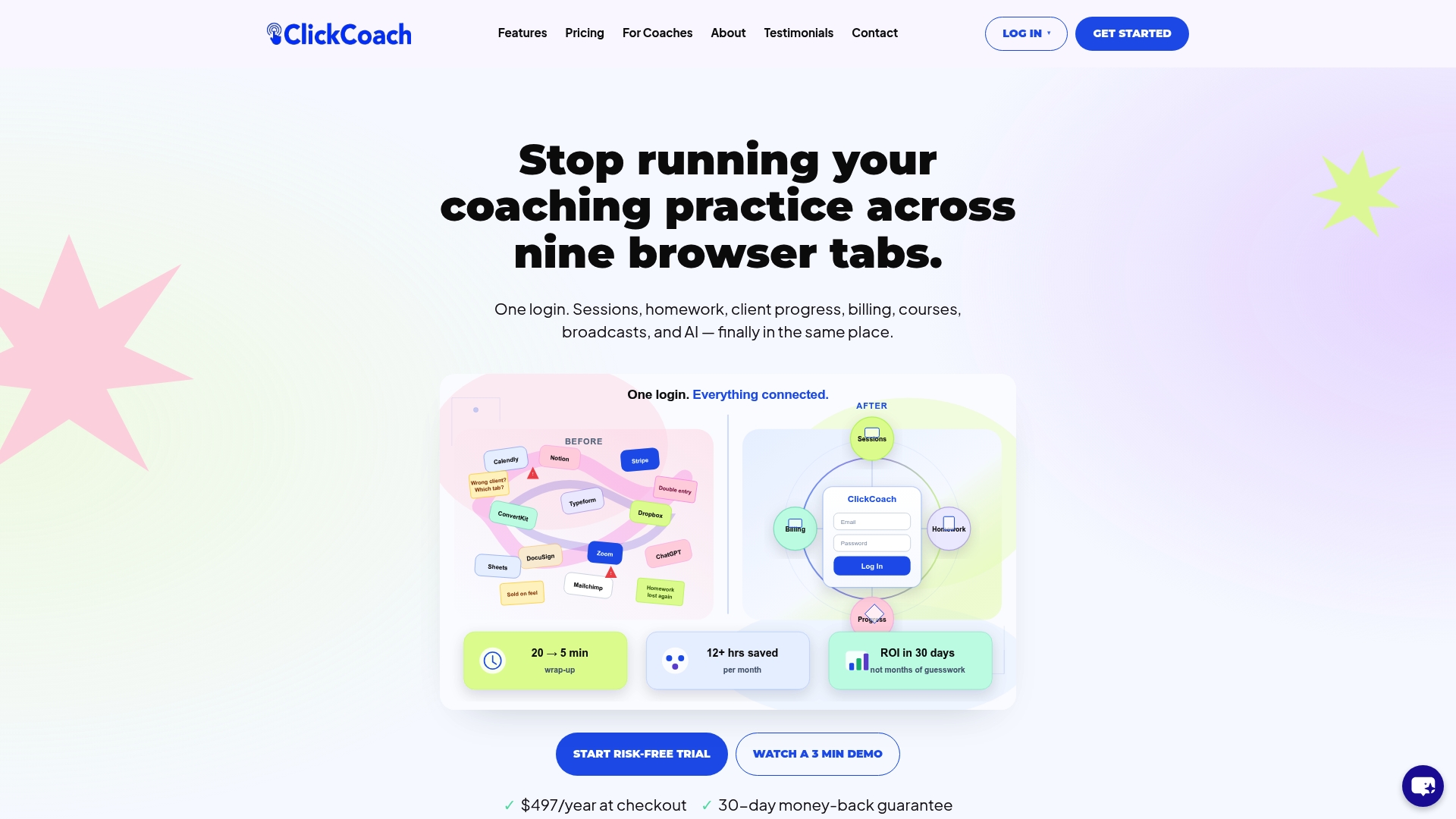
The platform automates recurring check-in delivery, tracks client responses in real time, and displays progress data in a centralized dashboard that you can review before every session. Coaches using ClickCoach report saving up to 20 minutes per session because client context is already visible before the conversation starts. You can manage client progress tracking alongside session scheduling, billing, and homework assignments without switching between apps. If you want a practice where recurring assessments run consistently without adding to your workload, ClickCoach is built for exactly that.
FAQ
What are recurring assessments in coaching?
Recurring assessments are structured check-ins administered repeatedly throughout a coaching engagement to track behavioral progress, goal attainment, and client engagement over time. They differ from one-time intake tools by providing continuous data rather than a single snapshot.
How often should a coach send client assessments?
A structure of 5–8 weekly questions combined with a monthly comprehensive review produces the best balance of data quality and client completion rates. Daily assessments create fatigue, while monthly-only check-ins miss critical week-to-week behavioral patterns.
Do recurring assessments improve client retention?
A structured execution layer with regular check-ins and visible progress tracking increases client tenure by 20–30%. Clients who see their own progress data stay engaged longer and report stronger ownership of their results.
What should a coach do when a client misses an assessment?
Missed submissions are diagnostic data, not failures. Approach the gap with curiosity by asking what got in the way, then use the answer to redesign the check-in format or adjust the client’s commitments to better fit their current capacity.
How do recurring assessments improve coaching session quality?
When coaches review assessment data before each session, they skip the status-update phase and move directly to strategic decisions. Between-session assessments also prompt client reflection, so clients arrive to sessions with greater clarity and readiness to engage.