

Progress reports are defined as structured, recurring communications that document client progress, completed work, and next steps against agreed goals. The role of progress reports in client retention is direct: they prove ongoing value, prevent the “trust vacuum” that causes clients to disengage, and keep service delivery aligned with what clients actually care about. Improving retention by just 5% can increase overall business profits by 25% to 95%. That single statistic reframes reporting from an administrative chore into one of the highest-return activities in your practice.
How do progress reports directly impact client retention rates?
The financial case for consistent reporting is clear. Retainer-based service providers face an 18% annual churn rate, compared to 42% for project-based providers. That gap exists largely because retainer relationships include built-in reporting rhythms that project work often skips. Regular updates signal ongoing commitment, and clients who feel informed are far less likely to leave.
The cost comparison reinforces this point. Acquiring a new client costs 5–25 times more than retaining an existing one. Every client you keep through better reporting is money you do not have to spend on marketing, outreach, or onboarding. For coaches running lean practices, that math matters enormously.
The data on timing is equally compelling:
- B2B service relationships with mid-cycle updates experience 38% less churn than those without them.
- Disciplined Quarterly Business Reviews (QBRs) correlate with 22–31 percentage point higher renewal rates.
- Brief, consistent updates outperform infrequent, lengthy reports in building client trust over time.
QBRs, in particular, are underused by independent coaches. A QBR is a structured 60-minute review where you and your client assess progress against quarterly goals, discuss obstacles, and agree on the next phase. Coaches who run them consistently report stronger contract renewals and more referrals from existing clients.
What makes an effective progress report for coaches?
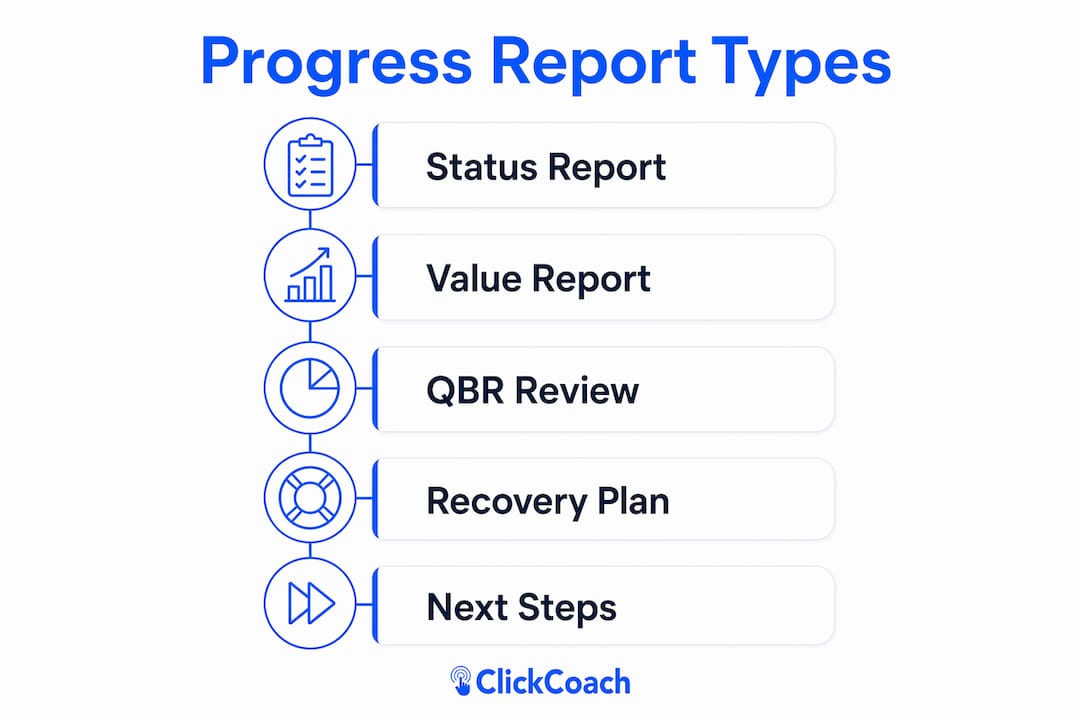
Not all progress reports serve the same purpose. The industry distinguishes two core types: status reports and value-based reports. Conflating them is one of the most common mistakes coaches make.

A status report covers day-to-day or week-to-week activity. It answers: what did we do, what comes next, and are there any blockers? Automated dashboards and brief weekly notes handle this well. They maintain operational momentum without requiring significant time from either party.
A value-based report does something different. It connects completed work to client goals, interprets results, and makes a case for continued investment. Value reports justify spend and align on strategy. They answer the question your client is always asking, even if they never say it out loud: “Is this worth it?”
The core elements every value report needs
A strong value-based report includes four components:
- Completed milestones tied explicitly to the client’s stated goals, not just a task list.
- Honest assessment of what worked and what did not, with specific context.
- A recovery plan when results fell short. Clients value honesty about underperformance paired with clear next steps far more than optimistic framing that glosses over problems.
- Recommended next actions that give the client a clear sense of direction.
Recommended reporting cadence
| Report type | Frequency | Primary purpose |
|---|---|---|
| Brief progress note | Weekly | Maintain visibility and momentum |
| Detailed value report | Monthly | Prove ROI and align on strategy |
| Quarterly Business Review | Every 3 months | Renew commitment and plan next phase |
Between 70% and 81% of service leaders identify strong, transparent reporting as extremely important for client retention. Allocating 4%–6% of your retainer budget to reporting activities is the recommended operational standard. For a coach charging $2,000 per month, that means roughly $80–$120 invested in reporting infrastructure, which is a small price for the retention gains it produces.
Pro Tip: Set a recurring calendar block for each report type at the start of every engagement. Clients who see a reporting schedule in their welcome packet feel more confident from day one.
Why does consistent communication build client trust and loyalty?
Consistent reporting functions as a feedback loop. Progress reporting prevents “setting and forgetting” by validating that performance aligns with client objectives on a regular basis. Without that loop, clients fill the silence with doubt.
The “trust vacuum” is real. When clients do not hear from you between sessions or deliverables, they start to wonder whether you are still focused on their goals. Silence kills coaching relationships. Small, consistent updates, even without big milestones to report, reduce churn caused by perceived inactivity. A two-paragraph mid-month note can do more for retention than a polished quarterly deck that arrives out of nowhere.
Transparency during difficult periods is especially powerful. Consider this principle:
Reporting transparency during underperformance can enhance client trust more than flawless reports. Honesty in client communications builds the kind of loyalty that survives setbacks.
Coaches who share honest assessments, paired with clear recovery plans, build deeper relationships than those who only report wins. Clients are not naive. They know that results are rarely linear. What they need to know is that you see the same reality they do and that you have a plan.
Consistent reporting also controls scope creep. When you document agreed goals and next steps in writing every month, both you and your client have a shared reference point. Misaligned expectations are caught early, before they become contract disputes or quiet cancellations. That alignment protects your time and your client’s investment.
How can coaches use progress reports to grow their practice?
Progress reports are not just a retention tool. They are a revenue engine for coaches who know how to use them well. Clients who see data-backed evidence of progress are more likely to approve expanded engagements and refer others. The report becomes the sales conversation you never have to force.
Here is how to embed growth opportunities naturally into your reporting practice:
- Highlight wins with context. Do not just list what improved. Explain what it means for the client’s larger goals. A client who sees the connection between your work and their outcomes is primed to invest more.
- Surface adjacent needs. If your report reveals a gap outside your current scope, name it. “We’ve made strong progress on X. The next constraint I’m seeing is Y, which we could address in an expanded engagement.” That is not a sales pitch. It is good coaching.
- Use data to position yourself as a partner. Data-driven reporting transforms service providers into strategic partners rather than vendors. Clients who see you as a partner renew. Clients who see you as a vendor shop around.
- Ask for referrals at peak moments. The best time to ask for a referral is immediately after a strong monthly or quarterly report. The client’s confidence in your work is at its highest. That is the moment to say, “If you know anyone facing similar challenges, I’d love an introduction.”
Pro Tip: Add a one-sentence “What’s next” recommendation at the end of every report. It keeps the client thinking forward and positions you as the natural person to help them get there.
For coaches looking to build proven client retention strategies into their practice, embedding growth conversations inside reporting is one of the most effective and least pushy approaches available.
Key Takeaways
Consistent, transparent progress reports are the single most effective client retention tool available to coaches and service providers, directly reducing churn and increasing profitability.
| Point | Details |
|---|---|
| Retention drives profit | A 5% retention gain can increase profits by 25%–95%, making reporting a high-return activity. |
| Use two report types | Separate weekly status notes from monthly value reports to meet different client needs. |
| Transparency builds loyalty | Honest reporting during setbacks builds more trust than reporting only good news. |
| Cadence prevents churn | Mid-cycle updates reduce churn by 38%; QBRs boost renewals by 22–31 percentage points. |
| Reports enable growth | Clients who see data-backed results are more likely to expand engagements and refer others. |
Why I stopped treating reports as paperwork
For years, I watched coaches treat progress reports as a box to check. They sent a PDF at the end of the month, listed what they did, and moved on. Then they were surprised when clients quietly let contracts lapse.
The shift happens when you stop asking “What did I do this month?” and start asking “What changed for my client this month, and why does it matter?” That reframe changes everything. The report stops being a summary and starts being a conversation. Clients read it differently. They respond to it. They bring it to their own team meetings.
The coaches I’ve seen retain clients at the highest rates are not the ones with the most polished templates. They are the ones who communicate honestly, even when the news is mixed. One coach I know sends a brief voice memo to clients after every session, just 90 seconds summarizing the key insight and the next step. Her renewal rate is exceptional. The format matters far less than the consistency and the honesty.
The other mistake I see constantly is waiting for a big milestone before sending an update. That waiting creates silence, and silence creates doubt. Send the small update. Tell your client what you noticed this week. Tell them what you are watching. That kind of communication is what separates coaches who build lasting practices from those who are always chasing the next new client.
Reports are not paperwork. They are the proof that you showed up.
— Mitch
How ClickCoach supports your reporting practice
ClickCoach was built for coaches who want to spend more time coaching and less time assembling reports. The platform brings session notes, client progress tracking, and homework assignments together under one login, so your reporting data is always current and easy to pull.
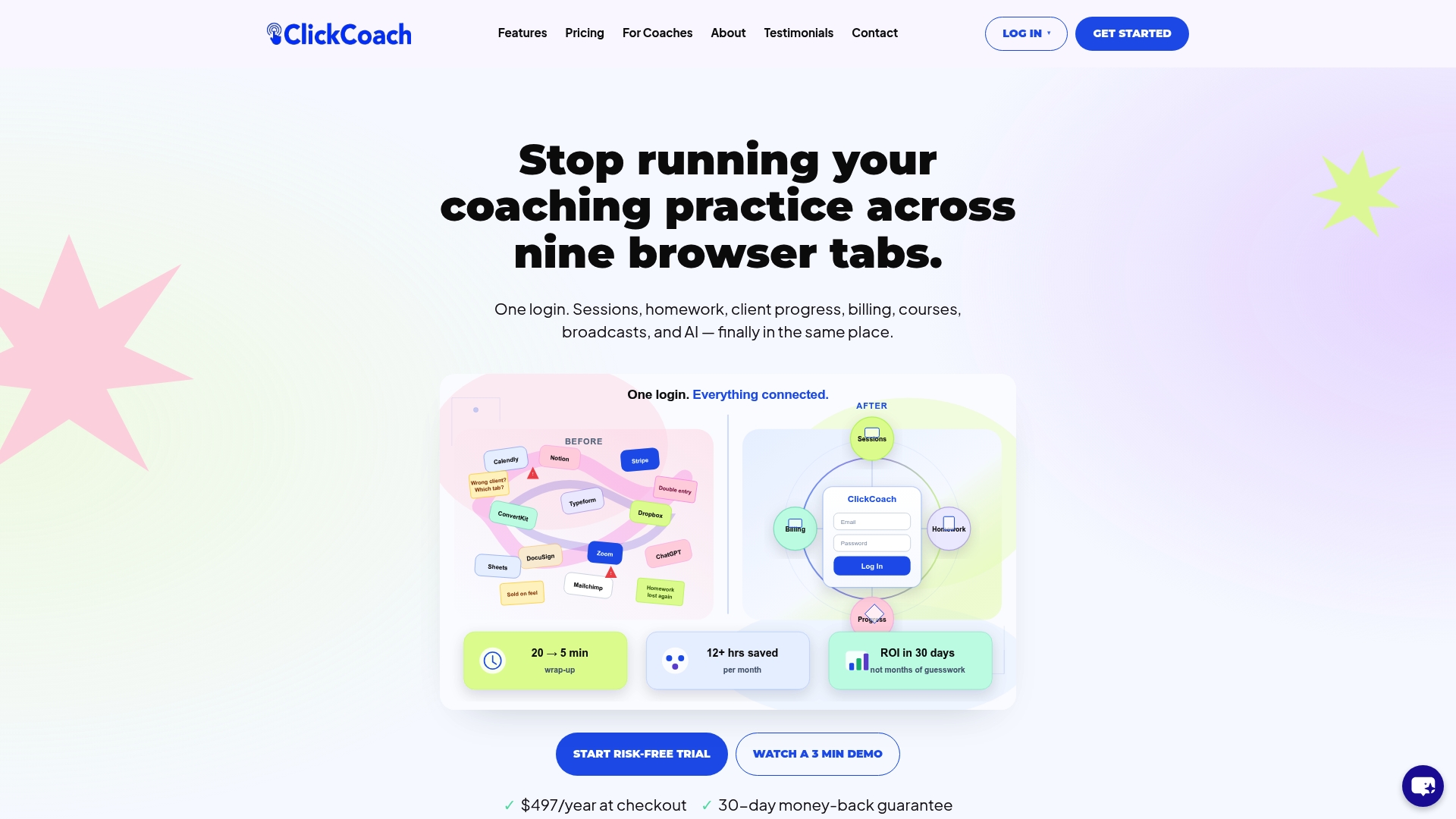
With ClickCoach, you can send branded progress updates directly through your client portal, maintain a consistent communication cadence without extra administrative work, and give clients a clear view of their progress between sessions. The platform’s AI assists with drafting updates and tracking milestones, saving coaches up to 20 minutes per session. If you are ready to make reporting a real part of your coaching practice, ClickCoach gives you the structure to do it without the overhead.
FAQ
What is the role of progress reports in client retention?
Progress reports prove ongoing value, maintain goal alignment, and prevent the trust vacuum that causes clients to disengage. Consistent reporting is directly linked to lower churn and higher renewal rates.
How often should coaches send progress reports?
The recommended cadence is brief weekly notes, detailed monthly value reports, and a formal Quarterly Business Review every three months. Mid-cycle updates alone reduce churn by 38%.
What should a coaching progress report include?
A strong report covers completed milestones tied to client goals, an honest assessment of results, a recovery plan for any shortfalls, and clear recommended next steps.
Does transparency about poor results hurt client relationships?
Transparency about underperformance, paired with a clear recovery plan, builds more long-term trust than reporting only positive results. Clients who feel informed stay longer.
Can progress reports help coaches grow their revenue?
Yes. Clients who see data-backed evidence of progress are more likely to approve expanded engagements and refer others, making reports a direct driver of practice growth.