

Between-session engagement is defined as the deliberate communication, activities, and follow-up that coaches maintain with clients outside of scheduled sessions. Coaches who increase client engagement between sessions see stronger accountability, faster progress, and higher client retention. The industry term for this practice is “intersession support,” and it covers everything from homework assignments to personalized check-ins. Personalized AI-driven content between sessions produces a 47% increase in client messaging and 24% more calls. That data proves one thing clearly: what you do between sessions shapes the entire coaching relationship.
What tools and channels effectively increase client engagement between sessions?
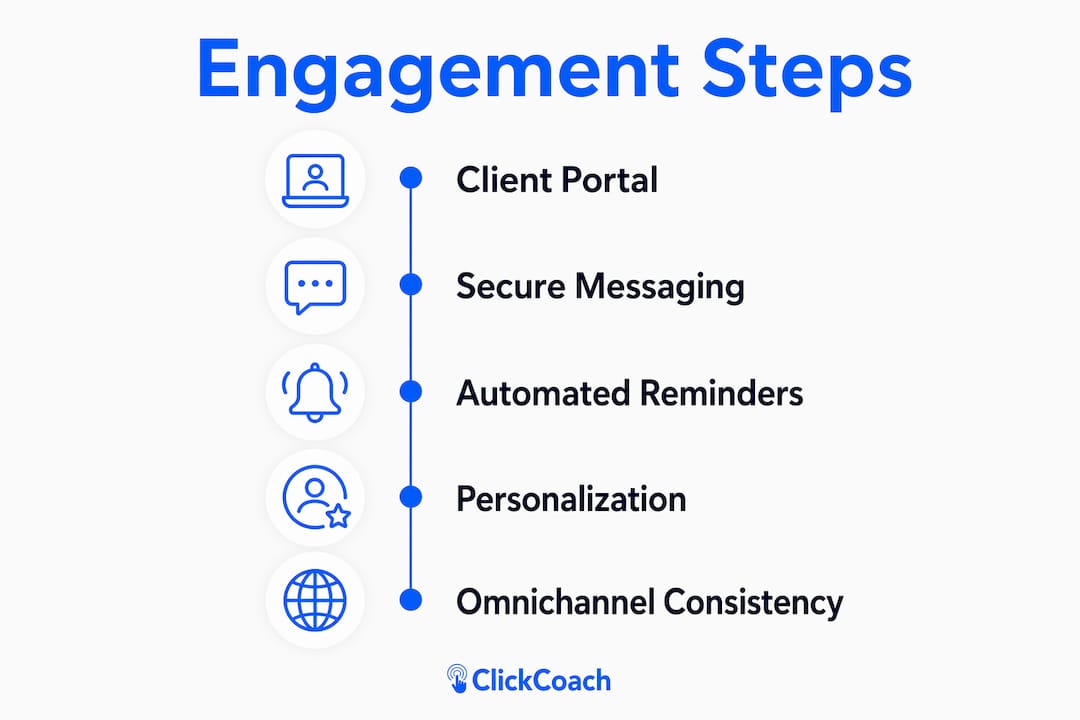
The right communication tools determine whether clients stay connected or drift between appointments. Coaches need a clear toolkit that covers multiple channels without creating chaos.
Client portals are the backbone of intersession support. A dedicated portal gives clients one place to review session notes, submit reflections, and track their own progress. 37% of clients get frustrated when they cannot complete simple tasks independently. A well-built portal removes that friction entirely.
Secure messaging and email check-ins keep the conversation alive without requiring a full session. Short, direct messages after a key milestone or before a challenging week signal that you are paying attention. These touchpoints do not need to be long. Two or three sentences can carry significant weight.

Automated reminders and push notifications handle the logistical side of engagement. A 24-hour pre-session reminder, a mid-week reflection prompt, or a homework due-date alert all reduce no-shows and keep clients on track. Video messages add a personal layer that text alone cannot replicate.
Omnichannel consistency ties everything together. 79% of clients expect consistent interactions across every communication channel. Fragmented touchpoints, where one message arrives by email, another by text, and a third through a portal, erode trust and create confusion.
Here is a quick comparison of common engagement channels by use case:
| Channel | Best use case | Engagement strength |
|---|---|---|
| Client portal | Progress tracking, homework submission | High |
| Secure messaging | Quick check-ins, milestone acknowledgment | High |
| Detailed updates, session summaries | Medium | |
| Push notifications | Reminders, time-sensitive prompts | High |
| Video messages | Personal encouragement, complex feedback | Very high |
Pro Tip: Use push notifications for time-sensitive reminders and reserve email for content that clients will want to reference later. Mixing these up trains clients to ignore both.
How to co-design intersession activities clients find meaningful
Co-designing intersession activities with clients is the single most effective way to boost follow-through. When clients help create their own tasks, they own the outcome. Research confirms that clients are significantly more likely to complete intersession activities when those activities are co-designed and aligned with their personal goals.
The co-design process does not require a long conversation. At the end of each session, ask the client what one or two actions would move them closest to their stated goal before you meet again. Their answer becomes the assignment. You refine it for clarity and feasibility. That shared authorship changes the client’s relationship with the task entirely.
Framing also matters. Calling an assignment “homework” activates a school-like dynamic that many adults resist. Calling it a “practice experiment” or a “progress check” positions the activity as a tool the client controls, not a test they might fail.
Key principles for co-designing effective intersession activities:
- Limit tasks to 2–3 items. Task fatigue sets in quickly when clients face long assignment lists. Two focused tasks outperform five vague ones every time.
- Tie each task directly to a stated goal. If a client’s goal is better work-life boundaries, the task should reflect that specific context, not a generic reflection exercise.
- Match the task format to the client’s style. Some clients prefer written journaling. Others prefer a voice memo or a quick rating scale. Ask which format they will actually use.
- Build in a simple completion signal. A checkbox in a portal or a one-line message saying “done” gives the client a moment of closure and gives you data to work with.
Pro Tip: At the end of every session, ask: “What is one thing you want to do before we meet again?” Then build the formal task list around that answer. The client’s own words carry more motivational weight than anything you assign.
For coaches working in sales and performance contexts, strategies that sustain client interaction between formal sessions follow the same co-design logic and produce comparable results.
What is the ideal timing and frequency for between-session communication?
Timing and frequency determine whether your communication feels supportive or intrusive. The goal is predictable contact, not constant contact.
- Send a 24-hour pre-session reminder. Predictably timed push notifications signal to clients that intersession work matters. A reminder the day before a session prompts clients to review their progress and arrive prepared.
- Schedule a mid-week check-in. A simple mid-week message via text or automated notice holds clients accountable and reduces no-show rates. It does not need to be a question. A brief acknowledgment of where the client is in their week is enough.
- Avoid daily contact unless the client requests it. Daily messages shift the dynamic from coaching to monitoring. Most clients disengage when communication feels like surveillance rather than support.
- Use push notifications over email for completion prompts. Push notifications reach clients in the moment. Email gets batched, delayed, and often ignored for time-sensitive tasks.
- Respect stated communication preferences. Some clients want morning messages. Others prefer end-of-day contact. Capture this preference at intake and honor it consistently.
The underlying principle is predictability. Clients who know when to expect contact from you build that contact into their routine. Unpredictable messages, even well-intentioned ones, create low-grade anxiety rather than accountability.
How does personalization improve the quality of between-session communication?
Generic automated messages do not build relationships. Personalization does. The most effective coaches maintain what communication specialists call a Client Context File: a living document that captures each client’s communication preferences, sensitivities, current challenges, and progress markers.
A maintained Client Context File enables AI tools to produce warm, precise, and personalized messages that clients perceive as authentic. That distinction matters. A message that references a client’s specific challenge from last week lands differently than a templated check-in that could have been sent to anyone.
What a strong Client Context File captures:
- Communication style preference: Does the client prefer direct feedback or a more exploratory tone?
- Active goals and current blockers: What is the client working toward right now, and what is getting in the way?
- Emotional sensitivities: Are there topics that require extra care or a specific framing?
- Session history highlights: What breakthroughs or setbacks have shaped the client’s recent progress?
- Preferred contact channel and timing: When and how does the client respond best?
Update this file after every session. The update takes two minutes and pays dividends across every subsequent interaction.
“Consistent weekly updates from coaches build client trust and confidence by demonstrating transparent, proactive care. Clients who receive regular, personalized communication report lower uncertainty and stronger commitment to their goals.”
Weekly proactive updates build the kind of trust that keeps clients engaged through difficult stretches. When a client knows you are tracking their progress and thinking about their situation between sessions, they show up more prepared and more motivated.
Common mistakes that reduce client engagement between sessions
Several well-meaning coaching behaviors actively undermine between-session engagement. Recognizing them is the first step to correcting them.
- Assigning too many tasks. Overloading clients with five or six intersession items signals poor judgment about their capacity. It also guarantees partial completion, which breeds guilt rather than momentum.
- Ignoring what clients reported. If a client submits a reflection or completes an activity and you never reference it in the next session, you signal that the work did not matter. That silence is one of the fastest ways to kill engagement.
- Reacting punitively to missed tasks. Clients who miss assignments already feel some degree of self-judgment. A coach who adds external judgment on top of that creates shame, not accountability. Curiosity works better than criticism every time.
- Using fragmented communication channels. Sending session notes by email, reminders by text, and homework through a third app forces clients to manage your disorganization. That friction compounds over time and erodes the coaching relationship.
- Sending generic, impersonal messages. A check-in that reads like a mass email tells the client they are not seen as an individual. Personalized communication, even a single specific detail, changes the entire tone.
The pattern behind most of these mistakes is the same: the coach prioritizes their own workflow over the client’s experience. Fixing that requires intentional design, not just good intentions.
Key Takeaways
Coaches who build consistent, personalized intersession support see stronger client commitment, fewer no-shows, and faster progress toward client goals.
| Point | Details |
|---|---|
| Personalization drives engagement | Personalized content between sessions produces a 47% increase in client messaging compared to generic outreach. |
| Co-design increases follow-through | Clients complete intersession tasks at significantly higher rates when they help create those tasks. |
| Limit tasks to 2–3 items | Keeping assignments brief and focused prevents task fatigue and improves adherence. |
| Predictable timing builds accountability | A 24-hour pre-session reminder and a mid-week check-in reduce no-shows and keep clients on track. |
| A Client Context File powers authentic communication | Maintaining a living record of client preferences and progress enables AI tools to produce warm, precise messages. |
What I’ve learned about engagement that most coaches overlook
The conventional advice on client engagement focuses almost entirely on frequency: check in more, send more reminders, stay in touch. That advice misses the point. Frequency without context is noise.
What actually moves clients between sessions is the feeling that their coach is paying attention to them specifically, not just running a process. I have seen coaches send daily messages that clients ignore completely, and I have seen a single well-timed, specific message change a client’s week. The difference is always context.
The coaches who sustain high engagement over months and years are not the ones with the most sophisticated automation. They are the ones who know their clients well enough to say the right thing at the right moment. Technology helps you do that at scale. It does not replace the judgment behind it.
The other thing most coaches underestimate is the cost of inconsistency. Clients do not disengage all at once. They drift. One missed check-in becomes two. One ignored submission becomes a pattern. By the time a coach notices the drop in engagement, the client has already mentally checked out. Building predictable, lightweight systems early in the coaching relationship prevents that drift before it starts.
— Mitch
How ClickCoach helps coaches build stronger between-session connections
ClickCoach brings session management, client progress tracking, homework assignments, and billing under one login, so you spend less time managing tools and more time coaching.
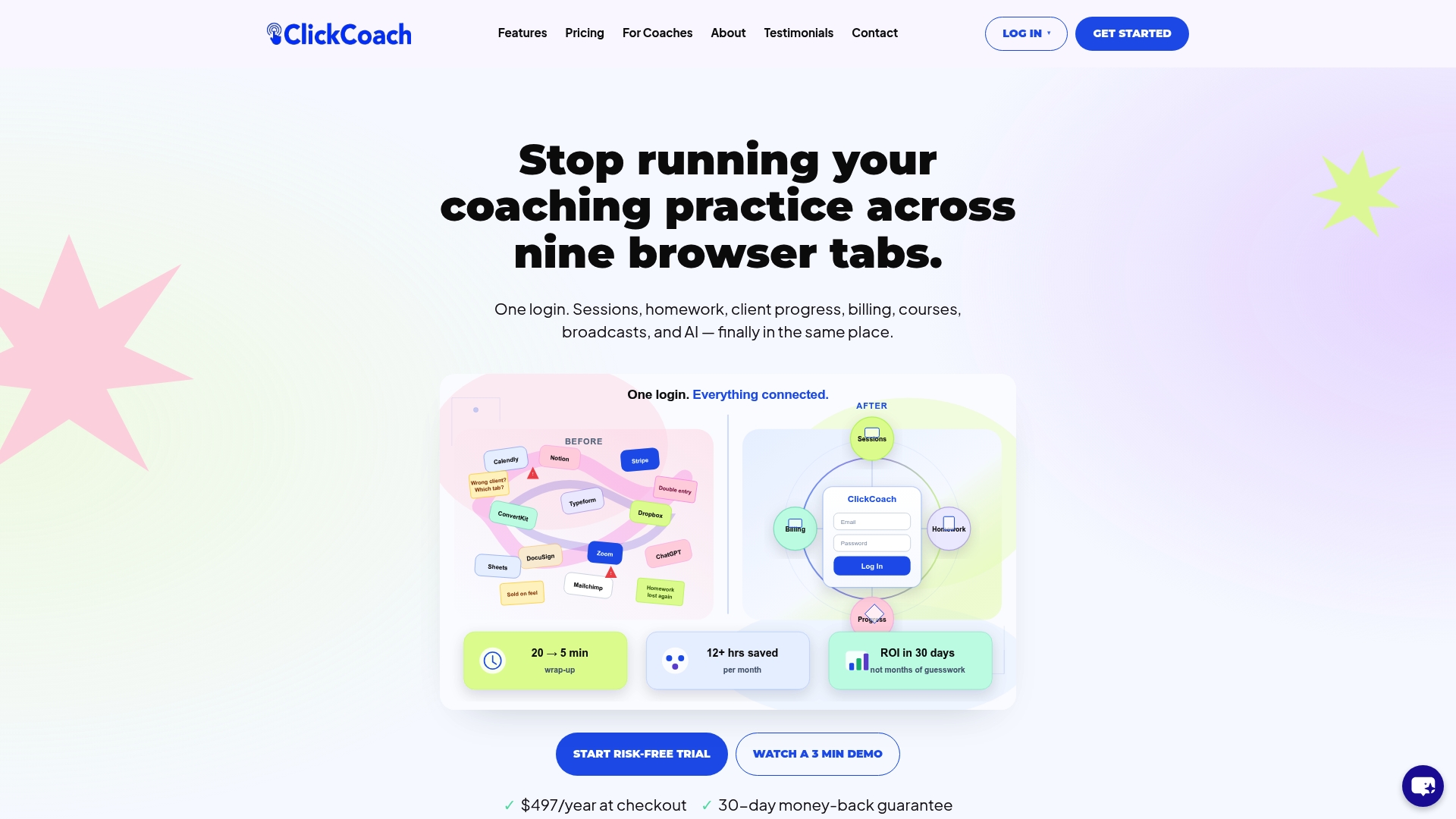
The platform’s client portals give your clients a branded, easy-to-use space to review notes, submit reflections, and track their own progress between sessions. ClickCoach’s AI assists with drafting personalized homework and follow-up messages, drawing on each client’s context to keep communication warm and specific. Coaches using ClickCoach report saving up to 20 minutes per session by eliminating the back-and-forth across multiple apps. If you are ready to build a more connected coaching practice, ClickCoach gives you the infrastructure to do it without adding complexity to your day.
FAQ
What is intersession engagement in coaching?
Intersession engagement refers to all communication, activities, and follow-up that occur between scheduled coaching sessions. It includes check-ins, homework assignments, progress tracking, and personalized reminders designed to maintain client accountability and momentum.
How often should a coach check in with clients between sessions?
A 24-hour pre-session reminder and one mid-week check-in represent the most effective baseline frequency. Daily contact risks feeling intrusive; no contact between sessions allows clients to drift and increases no-show rates.
Why do clients ignore between-session assignments?
Clients most often ignore assignments that feel irrelevant, too numerous, or imposed without their input. Limiting tasks to 2–3 focused items and co-designing them with the client dramatically improves completion rates.
Does personalization really make a difference in client communication?
Personalized AI-driven content between sessions produces a 47% increase in client messaging compared to unopened or generic content, which actually causes an 8% decrease in messaging. Specificity signals care and keeps clients engaged.
What is a Client Context File and why does it matter?
A Client Context File is a living document that captures each client’s communication preferences, active goals, sensitivities, and session history. It enables coaches and AI tools to produce messages that feel personal and relevant rather than automated and generic.