

Coaching session outcome documentation is the structured process of recording key insights, client commitments, and measurable progress indicators immediately after each session. The International Coaching Federation (ICF) recognizes session records as the most common and foundational form of coaching documentation, capturing discussion points, breakthroughs, and action steps. Without this process, coaches lose the thread of client progress between sessions and miss patterns that only become visible across multiple interactions. Effective coaching documentation transforms qualitative conversations into objective data that supports client accountability, sponsor reporting, and long-term coaching strategy.
What are the essential components of effective coaching session documentation?
Effective coaching documentation captures six core elements after every session. Miss any one of them and you create gaps that compound over time.
The six components are:
- Session details: Date, delivery format (video, phone, or in person), and a brief note on the client’s emotional and mental state at the start of the session.
- Session focus: The primary topic or goal the client brought to the session, stated in the client’s own words where possible.
- Key discussion points: The main themes explored, questions raised, and perspectives shifted during the conversation.
- Insights and breakthroughs: Specific moments where the client recognized something new about themselves or their situation.
- Client commitments and action items: Exact steps the client agreed to take before the next session, written as clearly as possible.
- Follow-up prompts: Questions or reflection exercises to open the next session and check on progress.
Capturing client language in documentation increases accountability and better reflects real progress. A client who said “I keep waiting for permission to lead” gives you a far richer record than a note that reads “client lacks confidence.” That exact phrase becomes a reference point for future sessions.
Pro Tip: Write commitments in the first person using the client’s words. “I will send the proposal by Friday” is more accountable than “client to send proposal.” It mirrors the language of ownership.

How does structured documentation support long-term client progress?
Single session notes capture a moment. Structured documentation across sessions captures a story. The difference matters because pattern recognition over time reveals recurring obstacles and growth areas that no individual session summary can show.
There are three distinct types of records that work together for long-term tracking:
- Session summaries: A concise record of what happened in each session, including insights, commitments, and the client’s state. These are the building blocks of all other documentation.
- Goal tracking logs: A running record of the client’s stated goals, any shifts in those goals, and the reasons behind those shifts. Goal evolution often tells a more revealing story than the goals themselves. A client who starts with “get promoted” and shifts to “find work I actually care about” has undergone a significant internal change worth documenting explicitly.
- Progress logs: A record of behavioral changes, completed commitments, and movement toward defined outcomes. These logs connect session activity to real-world results and form the evidence base for sponsor reporting.
Using all three types together lets you identify recurring themes. If a client consistently avoids a specific type of conversation at work, that pattern shows up across progress logs long before the client names it themselves. You can then bring that observation into the coaching conversation with specificity rather than intuition. That shift from gut feeling to documented evidence is what separates good coaching from great coaching.
Coaches who track goal changes also protect themselves professionally. When a client’s direction shifts significantly, having a documented record of the original goal and the reason for the change removes ambiguity and supports a clear coaching contract.
What methods and tools optimize post-session documentation?
Speed and structure are the two variables that determine documentation quality. The longer you wait after a session, the more detail you lose. The less structured your format, the harder it is to compare records across sessions.
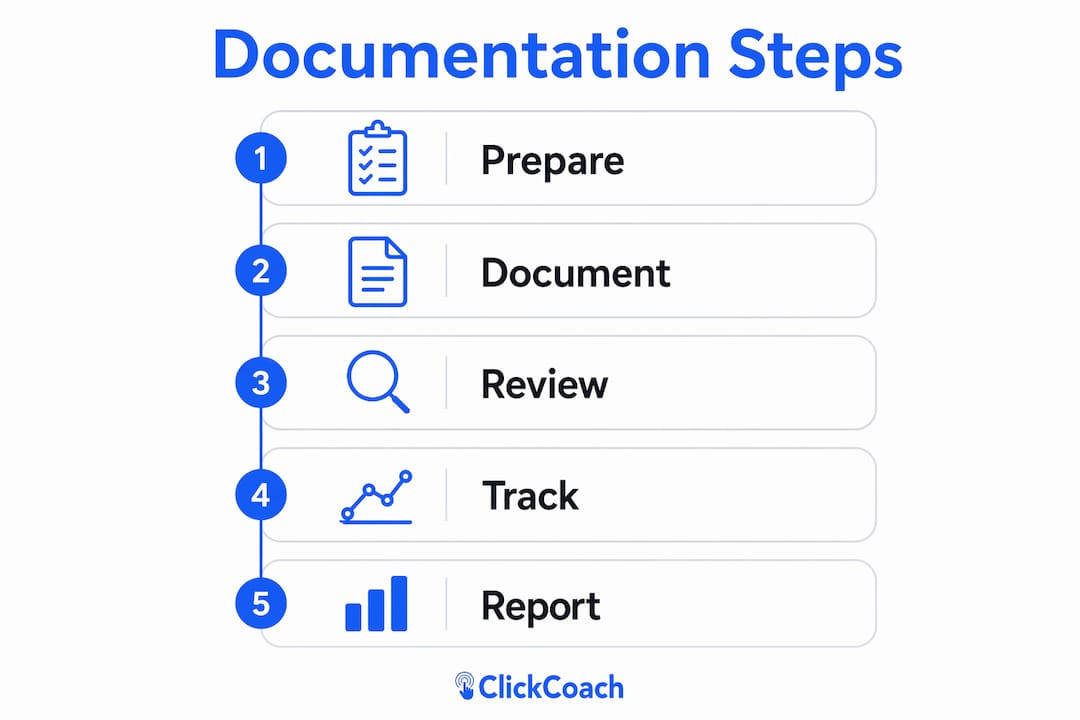
The industry standard is to complete documentation within 30 minutes of ending a session. At that point, coaches can generate up to 80 data points across 10 sessions by tracking presence and follow-through gaps consistently. That volume of structured data makes pattern detection reliable rather than anecdotal.
An eight-item post-session checklist covers the core observation categories:
| Category | What to capture |
|---|---|
| Coaching presence | Was I fully focused, or did I drift? |
| Active listening | Did I reflect back accurately? |
| Powerful questions | Did I ask questions that shifted perspective? |
| Client follow-through | Did the client complete prior commitments? |
| Goal alignment | Did the session serve the client’s stated goals? |
| Insight quality | Did a genuine shift occur? |
| Action clarity | Are next steps specific and time-bound? |
| Client language | Did I record exact phrases for accountability? |
Use a yes/no format with a brief note for each item. Documenting “No” responses is as valuable as documenting “Yes.” A consistent “No” on powerful questions across five sessions is a development signal you cannot afford to miss.
AI-assisted tools can now summarize session transcripts and flag cross-session patterns automatically. AI summarization captures key insights, decisions, and action items while detecting recurring themes that a coach reviewing notes manually might overlook. The efficiency gain is real, but the interpretation still requires human judgment.
Pro Tip: Set a calendar block for 30 minutes immediately after every session. Treat it as part of the session itself, not optional admin. Coaches who skip this block consistently report losing critical detail within two hours.
How to measure and report coaching outcomes to sponsors?
Reporting coaching outcomes to sponsors requires a different mindset than writing session notes. Session notes serve the coach and client. Sponsor reports serve the business case for coaching. Confusing the two leads to reports that feel anecdotal and fail to secure program renewal.
The Coaching Federation recommends agreeing on reporting architecture with sponsors at the start of the engagement. Pre-agreed outcome metrics shift the renewal conversation from justification to measurement. That distinction protects both the coach and the program.
A strong reporting framework uses three layers:
- Compliance layer: Confirms that sessions occurred, schedules were met, and the coaching contract was honored. This is the minimum viable report.
- Progress layer: Shows movement on behavioral goals using self-assessment scores and 360 feedback from stakeholders. This is where observable behavioral changes become visible to sponsors.
- Impact layer: Links coaching activity to operational KPIs agreed at the start. Combining self-assessment, 360 feedback, and one operational KPI can demonstrate up to 5x ROI on coaching investments. That number gives sponsors a concrete business case.
Avoid relying on satisfaction scores as your primary metric. Satisfaction measures how much a client enjoyed the experience, not whether they changed their behavior. Sponsors who fund coaching programs care about the second question, not the first.
For group coaching programs, use anonymized cohort themes to protect individual confidentiality while still showing organizational patterns. A report that says “six of eight participants identified delegation as a recurring obstacle” is both specific and safe. It also connects individual session documentation to a broader organizational insight, which is exactly what sponsors need to see.
The “arc of change” concept from the Coaching Federation describes how session themes and commitments connect over time to produce measurable business outcomes. Documenting that arc from the first session forward gives you a narrative that no single data point can provide. Coaches who build this narrative into their documentation practice from day one are far better positioned when renewal conversations arrive.
Career coaches working with individual clients can apply the same principles. Tracking behavioral shifts alongside job search outcomes gives both coach and client a clear picture of what is working and what needs to change.
Key Takeaways
Effective coaching session outcome documentation requires structured records, consistent timing, and pre-agreed reporting frameworks to convert coaching conversations into measurable client and business results.
| Point | Details |
|---|---|
| Document within 30 minutes | Complete your post-session checklist immediately to preserve accuracy and detail. |
| Use three record types | Combine session summaries, goal tracking logs, and progress logs for full client visibility. |
| Capture client language | Record exact client phrases to strengthen accountability and reflect genuine progress. |
| Agree on metrics early | Define outcome metrics with sponsors before the engagement starts to support renewal. |
| Track “No” responses | Documenting absent behaviors reveals development gaps that positive records alone cannot show. |
Why most coaches are documenting the wrong things
Most coaches I work with document what happened in a session. They write a summary of the conversation, note the action items, and move on. That approach feels thorough. It is not.
The real value of documentation is not in the record of a single session. It is in what you see when you lay ten sessions side by side. Which themes keep appearing? Which commitments keep getting deferred? Where does the client consistently avoid going? Those patterns are invisible in any one session note. They only emerge from structured, consistent records over time.
The shift from transcript-style notes to pattern-focused documentation is the single biggest upgrade most coaches can make. It changes how you prepare for sessions, how you challenge clients, and how you report results. Coaches who make this shift report that their clients feel more seen and more accountable, because the coach is bringing specific, documented observations rather than general impressions.
Technology helps, but it does not replace judgment. AI tools that summarize transcripts and flag recurring themes are genuinely useful. They reduce the time cost of documentation and surface patterns faster than manual review. The risk is treating the AI output as the finished record. It is a starting point. The coach still needs to interpret what the pattern means for this specific client at this specific stage of their development.
The coaches I respect most treat documentation as a clinical discipline. They are as rigorous about their records as a physician is about patient notes. That rigor is what makes their coaching repeatable, measurable, and defensible when sponsors ask hard questions.
Content creation for coaches who want to engage clients consistently follows the same principle: structure and consistency produce results that improvisation cannot.
— Mitch
How ClickCoach supports your session documentation practice
ClickCoach brings session notes, goal tracking, and client progress records into a single login, so you stop losing time switching between apps after every session.
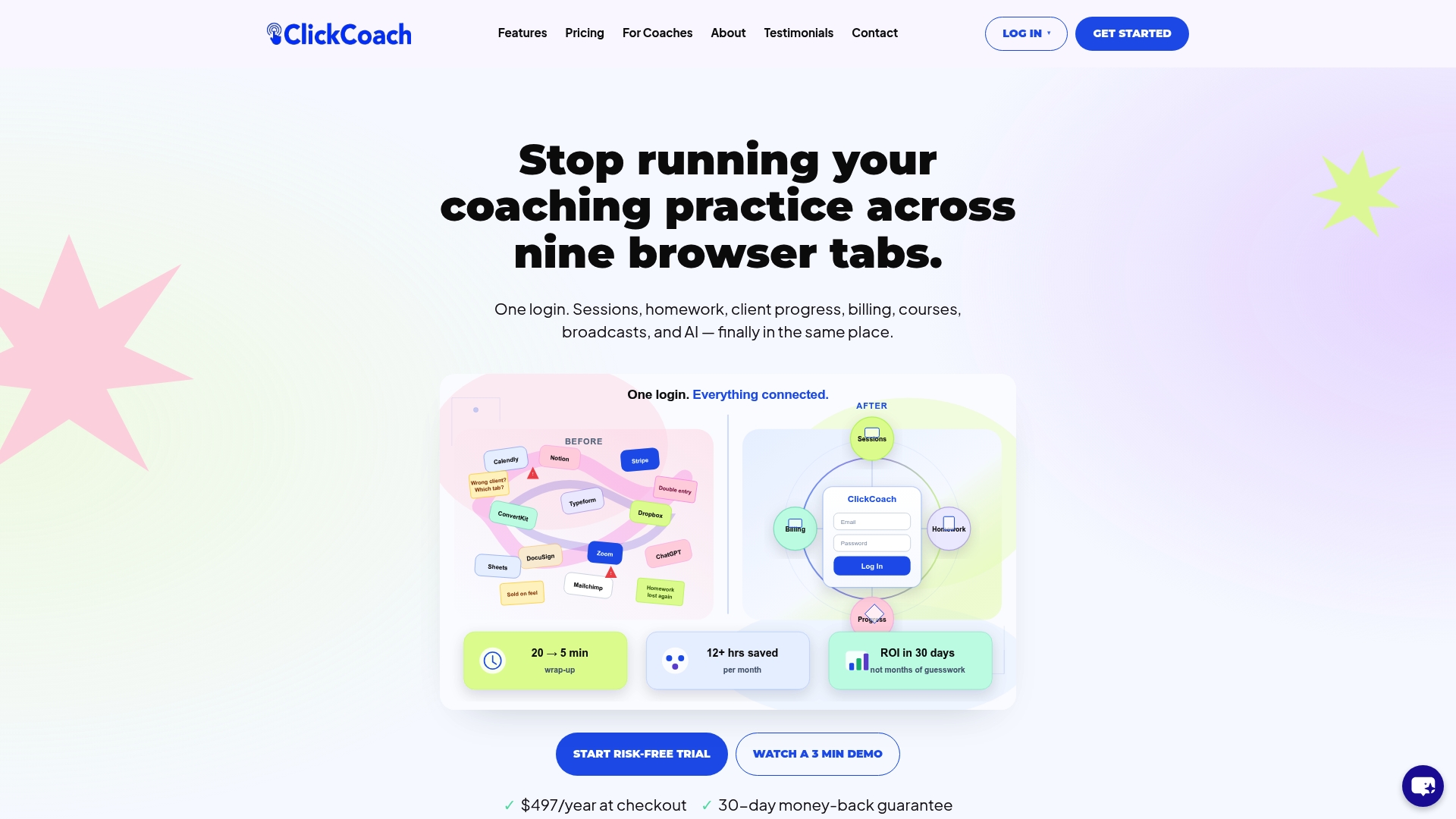
The platform includes built-in templates aligned with ICF documentation standards, covering all eight post-session observation categories. Coaches using ClickCoach report saving up to 20 minutes per session on admin, which adds up fast across a full client roster. The AI-assisted features help draft session summaries and flag recurring themes across client records, giving you the pattern recognition capability that manual notes rarely deliver. Sponsor-ready progress reports are generated directly from your session data, so renewal conversations are backed by evidence from day one. See how ClickCoach works for your practice.
FAQ
What is coaching session outcome documentation?
Coaching session outcome documentation is the structured process of recording session insights, client commitments, and measurable progress indicators after each coaching session. It forms the foundation for client accountability and sponsor reporting.
How soon should I document after a coaching session?
Complete your documentation within 30 minutes of ending the session. Waiting longer causes detail loss and reduces the accuracy of your records.
What types of coaching session documentation should I use?
Use three types: session summaries for individual session records, goal tracking logs for capturing goal evolution, and progress logs for linking behavioral changes to outcomes.
How do I report coaching outcomes to corporate sponsors?
Agree on outcome metrics with sponsors at the start of the engagement. Use a three-layer report covering compliance, behavioral progress, and operational KPIs to demonstrate measurable impact.
Why should I record “No” responses in my post-session checklist?
Documenting absent behaviors, such as a lack of powerful questions or incomplete follow-through, reveals development gaps that positive records alone cannot surface. These gaps are the most useful data for improving your coaching practice.