

For most new coaches, the fastest path to a sustainable income combines three streams: paid 1:1 coaching packages, one small group cohort program, and an evergreen digital product (a template, workbook, or short on-demand course). These three work together because the 1:1 work funds your early months, the group program multiplies your hourly rate, and the digital product builds passive revenue while you sleep. Industry benchmarks show that beginning coaches in their first year often earn modest initial income, while practitioners who diversify into multiple offerings tend to accelerate their earnings faster than those who rely solely on hourly sessions.
- Why these three streams? They cover the full client price ladder (low-cost entry, mid-range group, premium 1:1), they use the same core IP you already have, and each can generate a first sale within 7–30 days of launch.
- Speed to first revenue: A paid discovery call or 3-session package can sell within a week. A group cohort with 5–8 spots can fill in 30 days with the right outreach. A digital template can go live on Gumroad or Payhip in a single afternoon.
- Operational fit: All three run on the same client relationship infrastructure — scheduling, billing, progress tracking, and homework delivery — which is exactly what a platform like ClickCoach consolidates under one login.
Your 3-step action plan:
- Days 0–7: Define your niche, set a price for a 3-session discovery package, and sell three spots to warm contacts via direct message or email.
- Days 8–30: Outline your group cohort (6–8 weeks, 5–10 participants), open a waitlist, and publish one digital product (a worksheet or template) on a simple storefront.
- Days 31–90: Run your first cohort, collect testimonials, and build a basic email funnel to sell the digital product on autopilot.
Table of Contents
- What are the best revenue streams for new coaches?
- How do you launch each stream in 30–90 days?
- How do you choose which streams to build first?
- How should you price your coaching offers?
- How do you get paying clients for each stream?
- What are realistic timelines and startup costs?
- What tools do you need to run multiple streams efficiently?
- Key Takeaways
- The tradeoff most new coaches don’t talk about
- How ClickCoach helps you run and grow your practice
- Useful sources and further reading
What are the best revenue streams for new coaches?
The coaching income landscape splits cleanly into two categories: active streams, where you trade time for money in real time, and passive or semi-passive streams, where you build once and sell repeatedly. New practitioners should anchor in active streams first (they generate cash faster), then layer in passive options as their IP matures.
Active revenue streams
| Stream | What you sell | Typical buyer | Time to first revenue |
|---|---|---|---|
| 1:1 coaching packages | 3–12 session bundles | Individual clients | 1–7 days |
| Small group cohort | 6–10 week live program (5–15 people) | Motivated individuals | 14–30 days |
| Live workshops | 2–4 hour skill-focused session | Individuals or teams | 7–21 days |
| Corporate training | Half-day or full-day workshops for organizations | HR / L&D teams | 30–90 days |
| VIP day intensives | Full-day deep-dive, single client | High-ticket buyers | 14–30 days |

Passive and semi-passive revenue streams
| Stream | What you sell | Typical buyer | Time to first revenue |
|---|---|---|---|
| On-demand video course | Pre-recorded curriculum | Self-directed learners | 30–90 days to build; ongoing |
| Templates and workbooks | Downloadable tools | DIY buyers | 1–7 days to publish |
| Membership community | Monthly access to content + community | Ongoing learners | 30–60 days |
| Licensed IP | Your framework licensed to other coaches | Coaches, trainers | 60–180 days |
| Affiliate / referral revenue | Curated tool recommendations | Your existing audience | 7–14 days to set up |

Forbes notes that corporate contracts and training workshops are high-budget opportunities that translate the same coaching skills into larger-scale engagements. On the passive side, experts emphasize that passive income requires significant upfront work and ongoing marketing maintenance — it decouples time from money but is never truly “set and forget.”
Quick-start validation tip per stream: Before building anything, post a simple poll or direct question to your LinkedIn network, email list, or existing clients. Ask whether they would pay for the specific outcome your stream delivers. Three to five positive responses from real buyers is enough signal to start building a minimal version.
How do you launch each stream in 30–90 days?
Each of the ten streams below follows the same three-step launch structure: validate, build minimally, and sell before you perfect. Startup costs and time estimates reflect U.S. market conditions.
1. 1:1 coaching packages
What to sell: A 3-session starter package or a 3-month retainer (8–12 sessions).
- Write a one-paragraph offer description naming the specific outcome (e.g., “land your first VP role in 90 days”).
- Set a price ($500–$2,500 for a starter package; $1,500–$5,000 for a 3-month retainer) and send a direct offer to five warm contacts.
- Use a simple scheduling link (Calendly or Acuity) and a payment processor (Stripe or PayPal) to collect deposits.
Time to first revenue: 1–7 days. Startup cost: $0–$50/month for scheduling and payment tools. Effort: 2–4 hours to set up. Income potential: $24,000–$120,000/year at full capacity.
2. Small group cohort program
What to sell: A 6–8 week live program for 5–15 participants, meeting weekly via Zoom.
- Outline 6 session themes using your existing coaching framework or signature process.
- Open a waitlist with a Google Form or simple landing page; aim for 10–15 signups before committing to a start date.
- Sell founding-member spots at a 20–30% discount to fill the first cohort quickly.
Time to first revenue: 14–30 days. Startup cost: $0–$100 (Zoom, a simple landing page). Effort: 8–15 hours to build. Income potential: $5,000–$30,000 per cohort run.
3. Evergreen on-demand course
What to sell: A pre-recorded video curriculum (5–10 modules) hosted on Teachable, Thinkific, or Kajabi.
- Record a minimum viable version: 5 short modules (10–20 minutes each) using your existing session content.
- Set a price ($97–$497) and launch to your email list or LinkedIn audience with a 7-day open-cart window.
- After launch, build a simple email sequence to sell the course on autopilot.
Time to first revenue: 30–90 days to build; ongoing after launch. Startup cost: $29–$149/month for a course platform. Effort: 20–40 hours to produce. Income potential: $5,000–$50,000/year depending on traffic and price point.
4. Templates and workbooks
What to sell: Downloadable PDF or Notion templates (goal-setting worksheets, 90-day planning guides, client intake forms).
- Package one tool you already use with clients into a polished PDF or Notion template.
- List it on Gumroad, Payhip, or Etsy at $9–$49.
- Share it in three relevant online communities or on your LinkedIn profile with a direct link.
Time to first revenue: 1–7 days. Startup cost: $0–$10/month. Effort: 2–6 hours. Income potential: $500–$10,000/year as a supplementary stream.
5. Membership community
What to sell: Monthly access to a private community, live Q&A calls, and curated resources.
- Define the recurring value: one live call per month, a resource library, and a private Slack or Circle community.
- Set a monthly price ($29–$99/month) and recruit founding members from your existing audience at a discounted rate.
- Commit to a 90-day pilot before deciding whether to scale or restructure.
Time to first revenue: 30–60 days. Startup cost: $49–$99/month for a community platform. Effort: 10–20 hours to set up; 4–8 hours/month ongoing. Income potential: $1,000–$15,000/month at scale.
6. Live workshops and retreats
What to sell: A 2–4 hour skill-focused workshop (virtual or in-person) or a 1–2 day retreat.
- Choose one high-demand topic from your niche and build a simple slide deck or facilitation guide.
- Set a ticket price ($49–$299 for a virtual workshop; $500–$2,500 for an in-person retreat) and promote via email and social media.
- Partner with one complementary professional (a therapist, nutritionist, or HR consultant) to co-promote and split costs.
Time to first revenue: 7–21 days. Startup cost: $0–$200 for virtual; $500–$2,000 for in-person. Effort: 5–15 hours. Income potential: $1,000–$20,000 per event.
7. Corporate training
What to sell: Half-day or full-day workshops for organizations, delivered to teams of 10–50 people.
- Translate your signature coaching framework into a team-facing workshop with clear learning outcomes.
- Identify five target companies in your niche and reach out to HR or L&D contacts directly via LinkedIn.
- Propose a pilot workshop at a reduced rate ($1,500–$3,000) to earn a testimonial and a case study.
Time to first revenue: 30–90 days. Startup cost: $100–$500 for proposal materials and a basic website page. Effort: 15–25 hours to develop. Income potential: $3,000–$20,000+ per engagement. Emerging leaders in organizations benefit directly from structured coaching formats, which gives coaches a clear value proposition when pitching L&D teams.
8. VIP day intensives
What to sell: A full-day (6–8 hour) deep-dive session with one client, focused on a specific transformation.
- Define the VIP day outcome clearly: “By the end of this day, you will have a 90-day business plan and three priority actions.”
- Price it at $1,500–$5,000 and promote it to your existing 1:1 client base first.
- Create a pre-day questionnaire and a post-day action plan template to deliver a premium experience.
Time to first revenue: 14–30 days. Startup cost: $0–$50. Effort: 4–8 hours to package. Income potential: $18,000–$60,000/year at 1–2 VIP days per month.
9. Licensing your IP
What to sell: Your proprietary coaching framework, assessment, or curriculum licensed to other coaches or trainers.
- Document your framework in a clear, teachable format (a PDF guide, a facilitator manual, or a short certification program).
- Set a licensing fee ($500–$5,000/year per licensee) and identify potential licensees through coaching associations or LinkedIn.
- Draft a simple licensing agreement with the help of a contract template or an attorney.
Time to first revenue: 60–180 days. Startup cost: $200–$1,000 for documentation and legal review. Effort: 20–40 hours. Income potential: $5,000–$50,000/year depending on licensee volume.
10. Affiliate and referral revenue
What to sell: Curated recommendations for tools, platforms, and resources your clients already need.
- Identify three to five tools you genuinely use and recommend (scheduling software, course platforms, assessment tools) and apply for their affiliate programs.
- Create a simple “resources” page on your website listing your recommendations with affiliate links.
- Disclose affiliate relationships clearly in all content, as required by FTC guidelines.
Time to first revenue: 7–14 days to set up. Startup cost: $0. Effort: 2–4 hours. Income potential: $500–$5,000/year as a supplementary stream. Coaching resources recommend affiliate links and curated resource pages as low-maintenance supplementary income that builds trust when recommendations are genuine.
How do you choose which streams to build first?
The decision is not about which stream sounds most exciting. It is about which combination generates cash quickly, fits your current audience size, and uses the IP you already have. Industry guides consistently recommend that a sustainable coaching business operates with several primary revenue streams rather than chasing a long list of disconnected offers.
Decision checklist
Before committing to a stream, run it through these five filters:
- Client demand: Have at least three real people expressed interest in this specific outcome?
- Margin: Does the revenue justify the time and cost to deliver it?
- Time commitment: Can you deliver this without cannibalizing your core 1:1 work?
- Fit with your signature process: Does this stream reinforce or extend your core method?
- Scalability: Can you grow revenue in this stream without proportionally growing your hours?
Three starter combinations that work
Combination 1: 1:1 + Group Cohort + Template Best for coaches with a defined niche and a small but engaged audience. The 1:1 work funds your first 60 days, the cohort multiplies your hourly rate, and the template generates low-ticket passive sales. Practical guides show that repackaging your signature process into digital and live products expands your audience reach while funneling buyers into higher-priced offerings.
Combination 2: 1:1 + Corporate Workshop + Licensing Best for coaches with a corporate background or B2B network. The 1:1 work builds case studies, the workshop creates a scalable group format, and licensing generates recurring revenue from other practitioners. Organizations across industries are investing in coaching formats that develop teams, which gives this combination strong market timing.
Combination 3: Group Cohort + Evergreen Course + Membership Best for coaches who want to minimize 1:1 hours and build a scalable model from the start. This combination takes longer to generate meaningful revenue (60–90 days minimum), but it builds a recurring income base that grows with your audience.
Sample client journey
A buyer enters your world through a $27 template or a free workshop. They experience your method, trust your approach, and upgrade to a $497 group cohort. After the cohort, a portion of those clients invest in a 3-month 1:1 package at $2,500–$5,000. This progression means each stream feeds the next rather than competing for the same buyer.
Pro Tip: Test market fit before building. Send a direct message to 10 people in your network describing the specific outcome of your offer and asking if they would pay for it. If three or more say yes and ask how to sign up, you have enough signal to build a minimal version. If fewer respond, adjust the outcome or the audience before investing more time.
When to stop adding streams: if you are already running two streams and neither has reached consistent monthly revenue, do not add a third. Fix conversion and delivery first.
How should you price your coaching offers?
Pricing is where most new coaches leave money on the table, usually by undercharging for 1:1 work and overcomplicating their payment structures. The table below shows typical pricing ranges by stream type, mapped to the U.S. market.
Pricing ranges by stream type
| Stream type | Entry-level price | Mid-range price | Premium price | Typical payment model |
|---|---|---|---|---|
| Digital product (template, workbook) | $9–$27 | $27–$97 | $97–$497 | One-time purchase |
| Group cohort (6–8 weeks) | — | $500–$1,500 | $1,500–$3,000 | Upfront or 2-part payment |
| 1:1 package (3 months) | $1,500–$2,500 | $2,500–$5,000 | $5,000–$15,000 | Deposit + monthly installments |
| Corporate workshop (half-day) | $1,500–$3,000 | $3,000–$20,000 | $20,000+ | Invoice net 30, 50% deposit |
| Membership (monthly) | $29–$49 | $49–$99 | $99–$299 | Monthly or annual subscription |
| VIP day intensive | $1,500–$2,500 | $2,500–$5,000 | $5,000–$10,000 | 50% deposit, balance before day |
Payment structure guidance
For 1:1 packages, collect a 25–50% deposit at booking and the remainder before the first session. Never start a coaching engagement without a signed contract and a deposit in hand. Payment plans (two or three installments) increase conversion rates for packages priced above $2,000, but they also increase the risk of payment failure. Require automatic billing via Stripe or a similar processor rather than manual invoicing.
Corporate clients expect a formal proposal and a net-30 invoice. Always require a 50% deposit before delivering any corporate workshop. Include a clear cancellation clause: full deposit retained if the client cancels within 14 days of the event date.
For memberships, annual billing at a 15–20% discount reduces churn and improves cashflow. Monthly billing lowers the barrier to entry but creates more administrative overhead.
Consumer vs. corporate pricing
Consumer clients are price-sensitive and respond to outcome-based framing (“land your first $100K role”). Corporate clients are budget-driven and respond to ROI framing (“reduce manager turnover by improving leadership capability”). The same workshop can command three to five times the price when sold to an organization versus an individual, which is why corporate training is one of the highest-margin streams available to coaches.
What to include in every client proposal: scope of work, specific deliverables, session count and format, timeline, payment schedule, cancellation and refund terms, and a clear statement of what is not included. A one-page proposal with these elements closes faster than a lengthy document.
How do you get paying clients for each stream?
The channel that works depends on the stream. Selling a $27 template requires a different approach than closing a $10,000 corporate contract. The matrix below maps each stream to its most effective acquisition channels.
Channel-match matrix
| Stream | Primary channels | Secondary channels |
|---|---|---|
| 1:1 coaching | Direct outreach, referrals, LinkedIn | Email list, speaking |
| Group cohort | Email list, LinkedIn, partnerships | Organic content, webinars |
| Corporate training | LinkedIn, direct outreach to HR/L&D | Speaking, referrals |
| On-demand course | Organic content, SEO, email funnels | Paid ads (after validation) |
| Templates | Gumroad/Etsy marketplace, Pinterest | Email list, LinkedIn |
| Membership | Email list, existing clients | Organic content, partnerships |
| VIP day | Existing 1:1 clients, email list | LinkedIn, referrals |
A webinar funnel that converts
Webinars remain one of the most reliable conversion tools for group programs and courses. Here is a repeatable structure:
- Promote for 7–10 days via email and LinkedIn with a clear outcome promise (“In this 60-minute session, you will learn the three-step framework I use to help clients double their income in 90 days”).
- Run a 60-minute session: 10 minutes of context and credibility, 35 minutes of genuine teaching (give real value), 10 minutes presenting your paid offer, 5 minutes of Q&A.
- Make a time-limited offer at the end: a founding-member price or a bonus available for 48–72 hours only.
A 3-email launch sequence
Use this sequence to convert webinar signups or email subscribers into paying clients:
- Email 1 (Day 0 — the day of or after the webinar): “Here is what we covered + the offer.” Recap the key insight from the webinar, restate the offer, and include a direct link to enroll. Subject line: “What we covered today (and what’s next).”
- Email 2 (Day 2): Address the most common objection. For a group cohort, that is usually “I’m not sure I have the time.” Show them the time commitment in concrete terms (2 hours per week). Subject line: “The question I get most often about [program name].”
- Email 3 (Day 4 — closing email): Create urgency with a real deadline. “Enrollment closes Friday at midnight” or “Only 2 spots left.” Subject line: “Last chance — [program name] closes tonight.”
Low-cost plays for small audiences
You do not need a large list to sell your first offer. An engaged audience of a few hundred people can support a group program launch, a template sale, or a membership pilot. Three plays that work without an ad budget:
- Partner swaps: Find one complementary coach or consultant with a similar audience size. Each of you promotes the other’s offer to your list in a single email. No money changes hands.
- Micro-workshops: Host a free 30-minute workshop on a specific topic and pitch your paid offer at the end. Practical coach-business guides recommend starting with free or low-cost events to validate an offer and sell initial seats before investing in paid promotion.
- Referral incentives: Offer existing clients a $50–$100 credit toward their next package for every referral who books a paid session.
What are realistic timelines and startup costs?
Setting accurate expectations prevents the most common early mistake: spending money on tools and production before validating demand. The table below reflects typical U.S. market timelines and cost bands.
Timeline and cost overview by stream
| Stream | Launch window | First revenue window | Startup cost | Ongoing monthly cost |
|---|---|---|---|---|
| 1:1 coaching packages | 1–3 days | 1–7 days | $0–$50 | $20–$100 |
| Templates / workbooks | 1–3 days | 1–7 days | $0–$20 | $0–$10 |
| Live workshop (virtual) | 3–14 days | 7–21 days | $0–$100 | $20–$50 |
| VIP day intensive | 3–14 days | 14–30 days | $0–$50 | $0–$20 |
| Group cohort | 7–21 days | 14–30 days | $0–$200 | $30–$100 |
| Corporate training | 14–30 days | 30–90 days | $100–$500 | $0–$100 |
| Membership | 14–30 days | 30–60 days | $49–$200 | $49–$299 |
| On-demand course | 30–60 days | 30–90 days | $100–$500 | $29–$149 |
| Licensing IP | 60–120 days | 60–180 days | $200–$1,000 | $50–$200 |
| Affiliate revenue | 1–7 days to set up | 7–30 days | $0 | $0 |
ROI metrics to track from day one
Three numbers tell you whether a stream is working:
- Conversion rate: What percentage of people who hear about your offer actually buy? For a webinar-to-cohort funnel, 2–5% is a reasonable benchmark. For a direct-outreach 1:1 offer, 20–40% is achievable with warm contacts.
- Cost per acquisition (CPA): How much did you spend (in time and money) to land each paying client? Track this per stream so you know where your marketing effort is most efficient.
- Lifetime value (LTV) by stream: A 1:1 client who stays for 6 months at $1,500/month has an LTV of $9,000. A course buyer at $197 has an LTV of $197 unless you have a follow-on offer. Build your stream mix to maximize LTV, not just first-sale revenue.
Minimal viable spend vs. scaling spend: In your first 90 days, keep total tool and marketing spend below $200/month. Validate demand with direct outreach and free channels before investing in paid ads, a professional website, or premium course platforms. Once a stream generates consistent revenue, reinvest 10–20% of that stream’s income into scaling it.
What tools do you need to run multiple streams efficiently?
The operational reality of running three or four revenue streams simultaneously is that administrative work compounds fast. Scheduling, billing, client communications, content delivery, and progress tracking across multiple offers can consume 30–40% of a coach’s working week without the right systems in place.
Core operational needs
- Scheduling: A booking tool (Calendly, Acuity Scheduling) that handles time zones, buffer times, and automated reminders.
- Payments and subscriptions: A payment processor (Stripe, PayPal) that supports one-time payments, installment plans, and recurring subscriptions.
- Content hosting: A platform to deliver courses, session recordings, and resources (Teachable, Thinkific, or an all-in-one practice platform).
- Client portals: A dedicated space where each client can access their goals, homework, session notes, and progress data.
- CRM and pipeline: A simple system to track prospects, proposals, and conversion rates across streams.
- Contract signing: An e-signature tool (DocuSign, HelloSign, or built-in e-sign within a practice platform) to execute agreements before any engagement begins.
- Email automation: A tool (ConvertKit, Mailchimp, or ActiveCampaign) to run nurture sequences and launch emails.
- Analytics: Basic tracking of revenue by stream, conversion rates, and client outcomes.
How ClickCoach supports multiple streams
ClickCoach consolidates the core operational layer under one login: session management, billing and subscription management, client progress tracking, AI-powered homework creation, branded client portals, group coaching tools, course and learning management, CRM and prospects pipeline, e-sign contracts, file storage, and branded email broadcasts. For a coach running 1:1 packages alongside a group cohort and an on-demand course, that means one system handles the scheduling, the billing, the content delivery, and the client communication for all three streams simultaneously.
The platform’s AI assists in drafting homework and tracking client progress, which reduces session prep time by up to 20 minutes per session. Across a full client roster, that adds up to several hours per week returned to revenue-generating work. Clients interact through branded portals that give the practice a professional appearance from day one, which matters when you are asking someone to invest $2,500 in a coaching package.
90-day ops setup checklist
Set up systems in this order to avoid rebuilding later:
- Week 1: Payment processor (Stripe), scheduling link (Calendly or ClickCoach), and a basic contract template with e-sign capability.
- Week 2–3: Client portal or practice management platform, intake form, and session note template.
- Week 4–6: Email marketing tool and a 3-email welcome sequence for new clients.
- Week 7–10: Course hosting or group program delivery setup (if launching a cohort or course).
- Week 11–12: Analytics dashboard tracking revenue by stream, conversion rate, and client outcomes.
Key Takeaways
A sustainable coaching income comes from two to four complementary streams built in sequence, not from launching everything at once and hoping something sticks.
| Point | Details |
|---|---|
| Start with 2–4 streams | Industry guides recommend two to four primary streams; more creates operational complexity before you have the systems to handle it. |
| Active streams fund passive ones | Launch 1:1 coaching first for fast cash, then build group and digital products using the IP you develop in those sessions. |
| First revenue is faster than you think | Templates and 1:1 packages can generate a first sale within 1–7 days; a group cohort can fill in 14–30 days with direct outreach. |
| Price for the client type, not your comfort | Corporate buyers pay three to five times more than individual clients for the same framework; build a corporate offer early. |
| ClickCoach centralizes operations | Running multiple streams from one platform (session management, billing, courses, portals) saves up to 20 minutes per session and keeps client data in one place. |
The tradeoff most new coaches don’t talk about
The conventional advice is to diversify early and build multiple revenue streams as fast as possible. The reality is more nuanced. Every stream you add before your first one is working creates a new set of operational demands, a new marketing message, and a new set of client expectations to manage. The coaches who build sustainable practices fastest are usually the ones who resisted the urge to add a third stream until their first two were generating consistent, predictable revenue.
The tradeoff I see most often is speed versus quality. A coach who launches a group cohort before they have refined their 1:1 delivery often ends up with a mediocre group experience, weak testimonials, and a harder second launch. The better move is to run 10–15 strong 1:1 sessions first, extract the patterns in what your clients need, and then package those patterns into a group format. The cohort becomes better because the 1:1 work funded its development.
The same logic applies to passive income. A template or course built from real client work converts better than one built from theory. Your first digital product should be something you have already delivered manually to a paying client, then packaged into a reusable format. That sequence, active first then passive, is not just practical. It is how the best coaching IP gets built.
How ClickCoach helps you run and grow your practice
Managing 1:1 clients, a group cohort, and a digital product from three different tools creates the kind of administrative drag that quietly kills momentum. ClickCoach gives you one organized place to handle all of it: session scheduling, billing and subscriptions, client progress tracking, homework assignments, group coaching tools, and course delivery, all under a single login. Your clients get branded portals that make your practice look established from day one, and the platform’s AI cuts session prep time by up to 20 minutes per session, time you can redirect toward selling and delivering your next revenue stream.
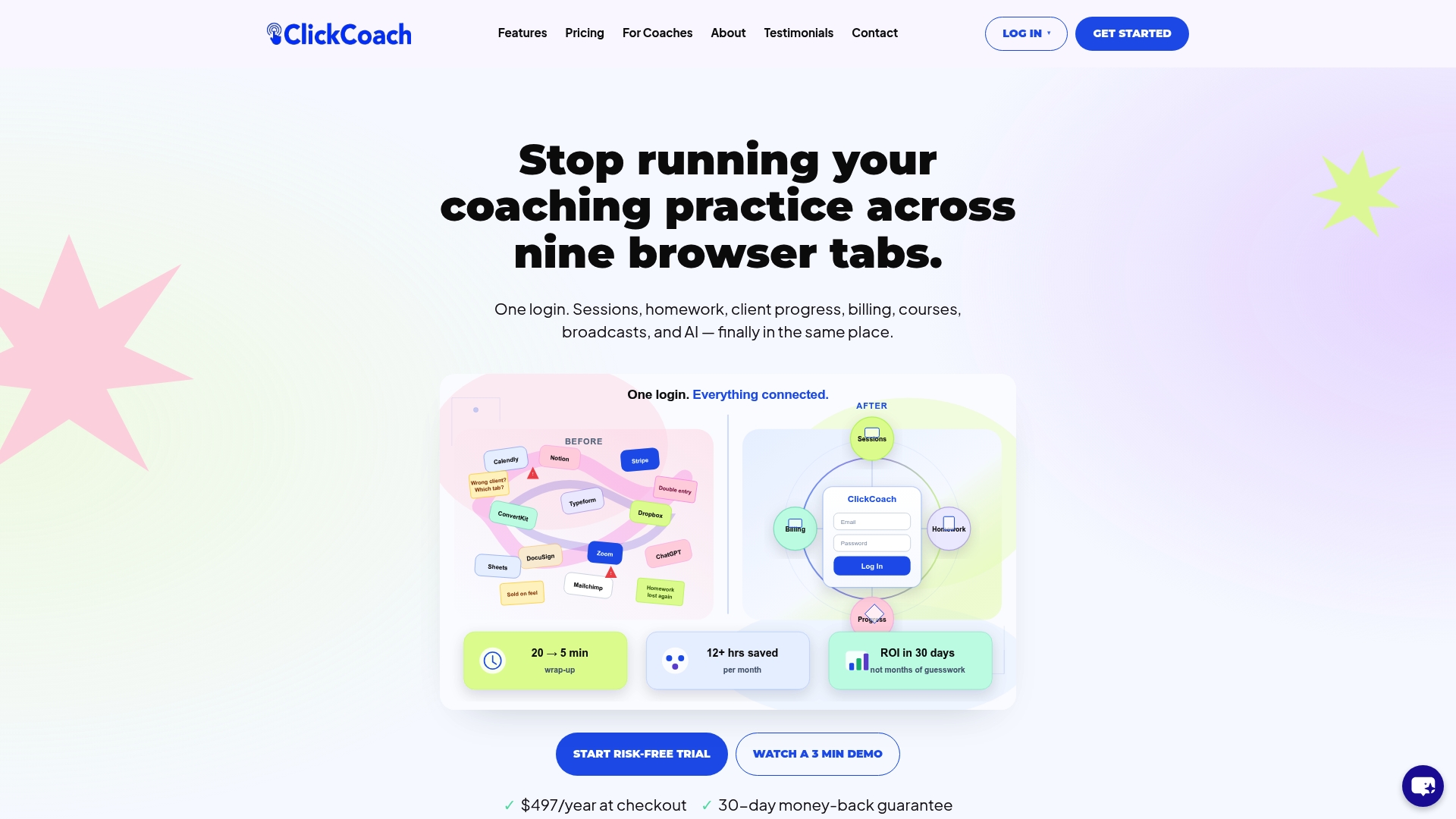
The platform runs on an annual subscription with a 30-day money-back guarantee, so you can test it against your real workflow without risk. If you are ready to stop juggling apps and start running a practice that can actually scale, explore ClickCoach and see how it fits the streams you are building.
Useful sources and further reading
The following sources informed this article and are worth reading for deeper context on specific streams:
- Forbes Coaches Council: 12 Ways Coaches Can Create Multiple Revenue Streams — broad overview of income diversification strategies for coaching entrepreneurs.
- Forbes Coaches Council: 10 Proven Strategies To Create Multiple Income Streams As A Coaching Entrepreneur — covers expanding services and building digital assets as validated growth strategies.
- Yes Supply: Passive Income as a Coach — 7 Proven Ways to Scale Revenue — detailed breakdown of passive income options and the maintenance effort each requires.
- HerIncomeEdit: Why Your Coaching Business Needs Multiple Revenue Streams — practical guidance on repackaging existing coaching IP into multiple product formats.
- QuietlyConquer: 6 Passive Income Strategies for Coaches — focused list of scalable passive options including courses, templates, memberships, and affiliate revenue.
- The Coach Business Guide: Multiple Streams of Income for Coaches — tactical, low-cost marketing plays for coaches launching first offers without large ad budgets.
- DollarPocket: Online Coaching Business Benchmarks 2025 — revenue and pricing benchmarks for coaching businesses at different experience levels.
- International Coaching Federation: 4 Strategies to Grow Your Coaching Practice — authoritative guidance from the ICF on practice growth and revenue strategy.
This article provides general business information for educational purposes. Consult a qualified legal or financial professional before making decisions about contracts, pricing structures, or business formation.