

Poor client management is the leading cause of coaching client loss, not weak coaching skills. Client churn data shows 35% of clients leave because they cannot see their progress, and 28% leave due to communication gaps. Only 17% cite money as the reason they quit. These numbers tell a clear story: your systems and communication habits matter more than your methodology. The client management mistakes coaches make are fixable, and fixing them is the fastest way to grow a stable, profitable practice.
1. Client management mistakes coaches make during onboarding
Onboarding is the single most important phase of any coaching relationship. The first 90 days set the tone for everything that follows, and a weak start rarely recovers. Coaches who skip a formal onboarding process lose clients before the real work even begins.

The 48-to-72-hour window between payment and the first session is the highest-risk period for early drop-off. Clients feel buyer’s remorse, second-guess the investment, and drift toward inaction if no substantive contact happens during this time. A quick confirmation call of 10–15 minutes outperforms an email or text every time.
Effective onboarding includes three non-negotiable elements:
- A welcome message sent within 24 hours of sign-up
- A structured first session with clear goals and expectations
- An initial progress baseline so both parties know where the client starts
Pro Tip: Send a short video welcome message within two hours of payment. It personalizes the experience immediately and dramatically reduces the anxiety that causes early drop-off.
Coaches who treat onboarding as a formality pay for it in churn. Coaches who treat it as a retention tool build practices that grow through referrals.
2. Skipping the formal coaching agreement
A written coaching agreement is not just a legal document. It is the clearest tool you have for preventing scope creep, setting boundaries, and protecting both parties from misaligned expectations. Coaches who skip it almost always regret it.
Scope creep is the most common result of a missing agreement. A client hired for career coaching starts asking for relationship advice. A fitness client expects nutritional meal planning that was never discussed. Without a written scope, the coach either overdelivers and burns out, or says no and damages the relationship.
A strong coaching agreement covers four areas:
- The specific scope of coaching services
- Communication channels and expected response times
- Cancellation and rescheduling policies
- Confidentiality and data handling
Pro Tip: Review the agreement verbally during the first session, not just in writing. Clients retain boundaries better when they hear them explained in your voice.
Formal agreements are recognized in 2026 as critical tools for sustainable coaching practices. Coaches who use them report fewer boundary violations and stronger client satisfaction scores.
3. Offering unlimited access and availability
Unlimited 24/7 client access increases burnout and damages trust. This surprises most coaches, who assume more availability signals more commitment. The opposite is true. Clients who can reach you at any hour begin to feel anxious when you do not respond instantly, and you begin to resent the practice you built.
Defined communication windows solve this problem. When clients know you respond to messages between 9:00 AM and 5:00 PM on weekdays, they plan accordingly. The relationship becomes predictable, and predictability builds confidence. Structured, predictable communication consistently outperforms open-ended availability in client satisfaction.
Set your communication windows in the coaching agreement and reinforce them during onboarding. If a client tests the boundary, address it directly and warmly. One clear conversation protects the relationship far better than silent resentment.
4. Failing to manage client execution
Client drop-off is most often a management problem, not a motivation problem. Clients do not quit because they stopped caring. They quit because no one is actively tracking their behavior, adjusting their plan, or holding them accountable between sessions. A coach who only delivers insight during sessions is only doing half the job.
The most effective coaches act as both coach and manager. They set a clear weekly cadence, conduct mid-week check-ins, and track whether clients are following through on commitments. This structure keeps clients engaged between sessions and reduces the drift that leads to cancellations.
Three practices that prevent execution failure:
- Weekly reviews that assess what happened, not just what was planned
- Mid-week check-ins via a structured message or short voice note
- An explicit agreement about what happens when a client misses a commitment
Overloading clients with tasks is the most common execution mistake. Coaches assign five habits, three readings, and two reflections, then wonder why nothing gets done. Focus on one key behavior per week. Clients who master one thing build momentum. Clients who attempt everything accomplish nothing.
5. Disorganized scheduling and missed follow-ups
Random or delayed responses make clients feel undervalued. This is not about being slow. It is about being inconsistent. A client who gets a reply in two minutes on Monday and two days on Thursday loses confidence in the relationship, regardless of the quality of your coaching.
Batching client communication into scheduled blocks solves the consistency problem. Set two or three daily windows for reading and responding to client messages. Outside those windows, close the inbox. This approach reduces the mental load of constant availability and makes your responses more thoughtful.
Pro Tip: Use automated session reminders sent 48 hours and 2 hours before each appointment. Missed sessions drop significantly when clients receive two reminders rather than one.
Delegating administrative tasks is the next step for coaches managing more than ten active clients. Scheduling, invoicing, and intake paperwork consume hours that belong in client-facing work. Coaches who delegate admin scale faster and deliver better sessions because they arrive prepared, not exhausted.
6. Ignoring the transition after initial goals are met
60% of clients who meet their initial goals leave because their coach never offered a follow-up or transition plan. This is one of the most expensive mistakes in coaching. You do the hard work of getting a client to their goal, and then you lose them at the moment they feel best about the relationship.
The solution is to introduce phase two before phase one ends. By week 8 or 9 of a 12-week program, the conversation should shift toward what comes next. Clients who are already thinking about their next goal do not experience the “I’m done” moment that triggers cancellation.
Effective transition planning includes:
- A specific offer for continued coaching at a new level
- A maintenance plan for clients who genuinely need a break
- A referral conversation for clients who are ready to move on
Career coaches who help clients land a new role, for example, can extend the engagement by shifting focus to onboarding success, leadership development, or the next career milestone. The goal is met, but the work is never truly finished.
Structured check-ins at 30, 60, and 90 days create natural touchpoints that intercept drop-off patterns early. Coaches who build these milestones into their program design retain far more clients than those who wait for clients to raise concerns.
7. Neglecting progress visibility for clients
35% of clients leave because they cannot see their own progress. This is a systems failure, not a coaching failure. The coach may be delivering excellent sessions, but if the client cannot look back and see how far they have come, they lose faith in the process.
Progress visibility requires deliberate design. Baseline assessments at the start of a program give clients a reference point. Regular progress reviews at weeks 4, 8, and 12 show movement against that baseline. Shared tracking tools let clients see their data between sessions, which reinforces commitment.
Coaches who use client progress tracking as a core part of their practice report stronger retention and more referrals. Clients who feel seen and measured stay longer and talk about the experience more.
8. Common billing mistakes coaches make
Billing errors erode trust faster than almost any other operational mistake. Late invoices, unclear payment terms, and surprise charges make clients feel like the relationship is transactional at the worst possible moment. The common billing mistakes coaches make are almost always the result of manual, inconsistent processes.
Automated billing solves most of these problems. Set up recurring payments for ongoing clients so invoices go out on the same day every month without manual effort. Clearly state payment terms in the coaching agreement, including late payment policies. Clients who understand the billing structure from day one rarely dispute charges.
Never send a first invoice without a conversation. Walk new clients through the payment process during onboarding. This removes confusion and signals that you run a professional practice.
Key takeaways
The most damaging client management mistakes coaches make are systems failures, not skill failures. Fixing onboarding, communication boundaries, execution tracking, and transition planning directly reduces churn and builds a more sustainable practice.
| Point | Details |
|---|---|
| Onboarding drives retention | Contact new clients within 48–72 hours of payment to prevent early drop-off. |
| Agreements prevent burnout | A written coaching agreement stops scope creep and sets clear communication boundaries. |
| Execution needs active management | Track client behavior weekly and focus on one key commitment per session. |
| Transition planning retains clients | Introduce phase two by week 8 to prevent churn after initial goals are met. |
| Progress visibility builds loyalty | Clients who can see their progress stay longer and refer more often. |
What I’ve learned about managing clients versus coaching them
I spent the first two years of my coaching practice believing that better sessions would solve everything. If I asked sharper questions, clients would stay. If my frameworks were tighter, clients would follow through. That belief cost me a lot of good clients.
The shift happened when I started treating client management as a separate discipline from coaching itself. I realized that the coaches I admired most were not just insightful. They were organized. They had systems. They followed up. They made clients feel held between sessions, not just during them.
The hardest part was accepting that structure and warmth are not opposites. Clients do not experience boundaries as cold. They experience them as professional. When I defined my communication windows and stopped answering messages at 10:00 PM, my clients did not feel abandoned. They felt like they were working with someone who respected their own time, and by extension, theirs.
The coaches I see burning out today are the ones still trying to coach their way out of management problems. A step-by-step approach to building client management systems, the same way you would build a coaching methodology, is what separates practices that scale from practices that stall.
— Mitch
How ClickCoach helps coaches avoid these mistakes
Managing onboarding, communication, scheduling, billing, and progress tracking across multiple clients is genuinely hard without the right infrastructure.
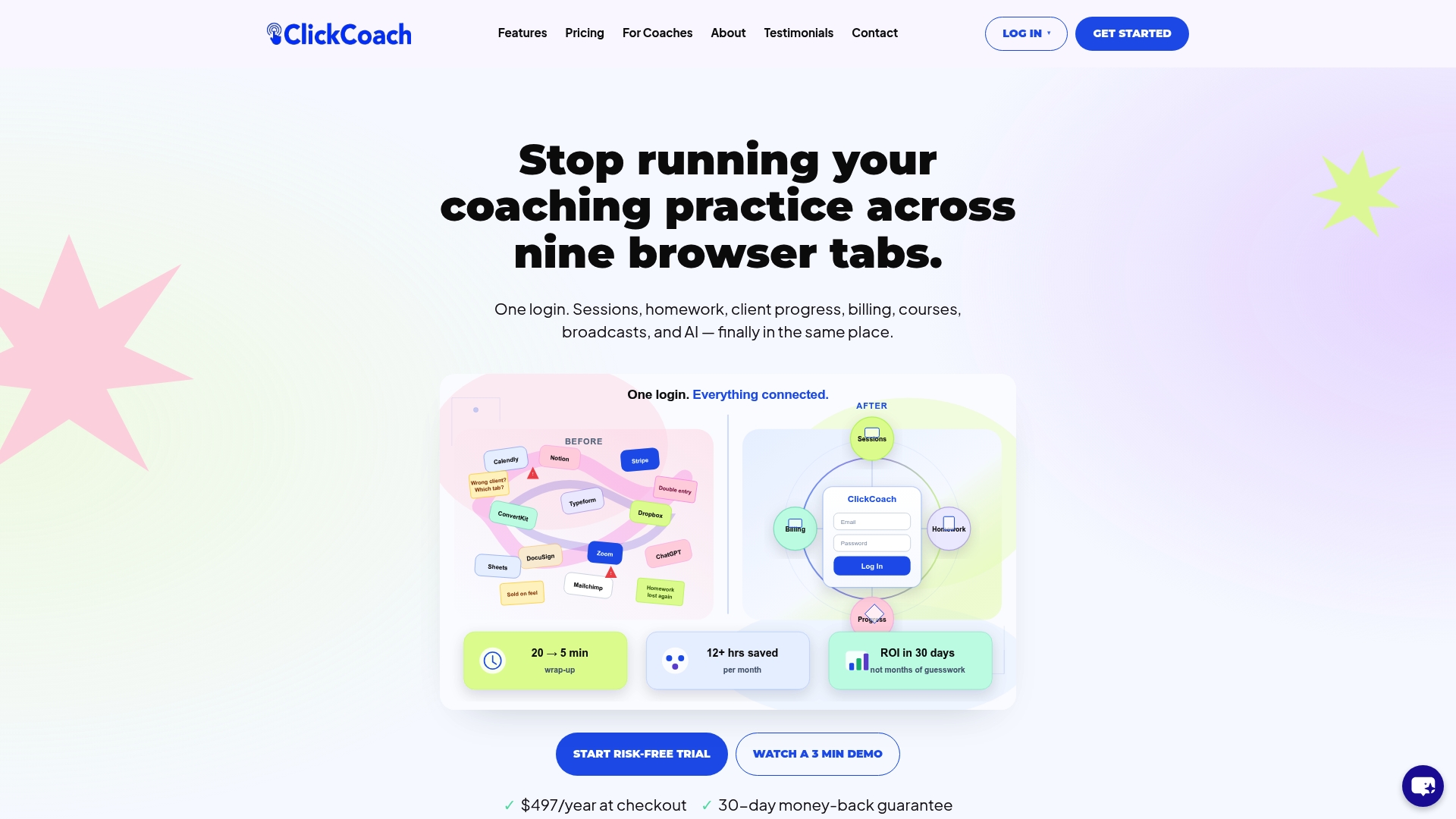
ClickCoach brings all of it under one login, so you stop losing time to administrative chaos and start spending it on clients. The platform handles session management, automated billing, client progress tracking, and homework assignments in one place. Coaches report saving up to 20 minutes per session by eliminating the back-and-forth between disconnected tools. ClickCoach’s AI assists with drafting homework and tracking client progress, so your clients always feel seen and supported. If you are ready to run a more professional, organized practice, ClickCoach is built for exactly that.
FAQ
What are the most common client management mistakes coaches make?
The most common mistakes are weak onboarding, missing coaching agreements, offering unlimited availability, and failing to plan client transitions after goals are met. Poor systems drive client churn far more often than poor coaching skill.
Why do coaching clients drop off after reaching their goals?
60% of clients who meet initial goals leave because their coach never offered a transition or follow-up plan. Introducing phase two by week 8 or 9 prevents this pattern.
How do communication boundaries improve client satisfaction?
Defined communication windows create predictability, which builds client confidence. Unlimited availability increases coach burnout and makes clients anxious when responses are delayed.
What is the biggest billing mistake coaches make?
Sending invoices without explaining the payment process during onboarding is the most common billing error. Automated recurring billing and clear payment terms in the coaching agreement prevent most disputes.
How can coaches improve client execution between sessions?
Focus on one key behavior per week rather than multiple assignments. Mid-week check-ins and explicit accountability agreements keep clients on track and reduce the drift that leads to cancellations.