

Client communication best practices for coaches are structured routines and clear rules that build trust, drive accountability, and keep clients engaged between sessions. Coaches who rely on ad hoc outreach lose clients not because of poor coaching, but because of poor communication systems. The International Coaching Federation recognizes consistent client contact as a core competency, and research confirms that clients leave when they feel ignored, making predictable touchpoints a retention tool, not a luxury. This article gives you a concrete framework to communicate with confidence, protect your time, and keep clients committed.
1. What are the essential client communication best practices for coaches?
Effective coach-client communication rests on three pillars: regular touchpoints, clear channel rules, and response-time promises. Without all three, even excellent coaching sessions lose their impact.
Regular touchpoints between sessions are non-negotiable. At least one substantive check-in between sessions, such as a mid-week progress review or a brief voice message, keeps clients connected to their goals. Clients who hear nothing between sessions often lose momentum and start questioning the value of the program.
Channel rules reduce confusion and protect your focus. A simple framework works well:
- Email for detailed questions, session recaps, and documents
- Text or platform messaging for urgent logistics only
- Your coaching platform for session notes, homework, and progress tracking
Response-time promises set expectations before anxiety builds. A 24-business-hour response window is the industry standard for professional boundary setting. Communicate this window clearly in your welcome packet and onboarding call, so clients know what to expect from day one.
Pro Tip: Create a one-page “Communication Guide” for every new client. List your channels, response times, and what counts as an emergency. This single document eliminates 80% of boundary friction before it starts.
2. How to build a communication system that balances structure and empathy
Structure is not the opposite of warmth. Clients commit more deeply when the system clearly expects their participation. Treating check-ins as optional signals that the work is optional too.
The most effective coaching communication techniques use layered questioning. Ask “What happened?” and “When did that occur?” rather than “Why did you do that?” Fact-based questions reduce defensiveness and ground the conversation in observable events. Clients can answer “what” and “when” without feeling judged. “Why” triggers self-protection.
“Clients act not because they understand but because they feel accurately understood and clearly guided without judgment.”
This insight reframes the coach’s job. Your role is not to explain more clearly. Your role is to listen precisely, reflect accurately, and then guide without shame. That combination builds the psychological safety clients need to take real action.
A practical framework for difficult conversations follows four steps:
- Name the observable fact (“You missed two check-ins this week.”)
- Ask a fact-based question (“What got in the way?”)
- Acknowledge the answer without judgment (“That makes sense.”)
- Co-create a new agreement (“What would work better next week?”)
This sequence keeps accountability intact without inducing shame or defensiveness. Coaches who skip step three often find clients go quiet or drop out entirely.
3. What strategies help coaches set clear boundaries and avoid burnout?

Burnout in coaching practices almost always traces back to communication without limits. Defining message windows protects your focus and reduces client uncertainty at the same time.
A message window is a defined period each day when you read and respond to client messages. Twice-daily windows, such as 9:00 AM and 4:00 PM, work well for most coaches. Clients learn quickly when to expect a response, and you stop feeling tethered to your phone.
Key boundary practices that prevent burnout:
- Separate coaching hours from messaging hours. Never respond to messages during a session with another client.
- Create an emergency protocol. Define what counts as a genuine emergency and provide one clear channel for it. This removes ambiguity without leaving clients stranded.
- Stop apologizing for your rules. Communication rules are liberating guardrails that maintain trust. When a system slips, fix it with a calendar adjustment, not an apology.
- Consolidate your tools. Running messages across email, text, WhatsApp, and a coaching platform creates cognitive overload and lost threads.
Pro Tip: Block your message windows directly in your calendar as recurring appointments. Treat them like client sessions. When the time is protected visually, you are far less likely to drift into reactive responding.
4. How do coaches maintain client engagement and satisfaction between sessions?
Client retention is built in the first 90 days. Scheduling renewal conversations 30 days before a contract ends reduces anxiety and keeps engagement high through the final weeks of a program. Coaches who wait until the last session to discuss renewal often lose clients who assumed the relationship was ending.
Planned outreach between sessions keeps clients feeling supported without requiring hours of extra work:
- Milestone celebrations: Send a brief message when a client hits a goal. Recognition between sessions reinforces progress and strengthens commitment.
- Resource sharing: Drop a relevant article, worksheet, or audio clip tied to the client’s current focus. This creates engaging coaching resources clients actually use.
- Progress dashboards: Visible progress tracking gives clients a concrete sense of movement. Clients who can see their progress are less likely to disengage.
The table below shows how to structure outreach across a typical coaching month:
| Week | Outreach Type | Purpose |
|---|---|---|
| Week 1 | Welcome or re-entry message | Set tone and expectations |
| Week 2 | Mid-week check-in | Maintain momentum |
| Week 3 | Resource share or milestone note | Reinforce progress |
| Week 4 | Progress review prompt | Prepare for renewal or next phase |
Automating routine messages such as session reminders and resource drops solves the “I meant to follow up but forgot” problem. Automation handles the consistent contact so you can focus your personal attention where it matters most.
5. How to choose and implement the right tools for scalable client communication
Tool overload harms communication efficiency. Coaches who manage client relationships across five disconnected apps spend more time searching for messages than responding to them. The right communication hub is searchable, consistent, and integrated with your session and billing workflow.
An ideal platform for coaching communication supports:
- Centralized messaging with a full conversation history
- Automated reminders and scheduled outreach
- Client portals where homework, notes, and progress live in one place
- Templates for recurring messages like session prep and follow-up
Pro Tip: Before adding any new tool, ask one question: does this replace something I already use, or does it add another inbox to check? If it adds an inbox, skip it.
Small coaching cohorts and AI-powered resource recommendations let coaches maintain a personal feel without scheduling a 1:1 call for every touchpoint. The goal is not to automate the relationship. The goal is to automate the logistics so the relationship gets your full attention.
ClickCoach brings session management, billing, progress tracking, and client messaging under one login for your practice. Coaches using ClickCoach report saving up to 20 minutes per session by eliminating the time spent switching between apps.
Key Takeaways
Effective coach-client communication requires structured touchpoints, defined boundaries, and the right tools working together to retain clients and protect coach capacity.
| Point | Details |
|---|---|
| Regular touchpoints prevent dropout | Schedule at least one substantive check-in between every session to keep clients engaged. |
| Response-time promises reduce anxiety | Commit to a 24-business-hour window and communicate it clearly during onboarding. |
| Structure signals care | Clear participation expectations increase client commitment, not resentment. |
| Retention is built in 90 days | Plan renewal conversations 30 days before contract end to reduce client anxiety. |
| Tool consolidation protects focus | One integrated platform beats five disconnected apps for both coach and client experience. |
Why I stopped winging client communication (and what changed)
Early in my coaching practice, I treated communication as something that happened between the “real work” of sessions. I responded whenever I had a moment, followed up when I remembered, and felt vaguely guilty about the clients I had not checked in with that week. The result was inconsistent relationships and clients who quietly drifted away.
The shift came when I stopped thinking of communication as reactive and started treating it as a designed system. I set message windows. I wrote templates. I scheduled milestone messages in advance. Clients did not feel less cared for. They felt more cared for, because the contact was reliable.
The fear that structure feels cold is real, but it is wrong. Clients do not want a coach who is always available. They want a coach who shows up predictably and fully. A defined check-in at 10:00 AM Wednesday carries more weight than a scattered text sent whenever you remember.
The hardest part was giving up the idea that being responsive 24/7 proved I cared. It did not. It just proved I had no system. Once I built the system, I had more energy for the conversations that actually mattered, and my clients noticed.
— Mitch
How ClickCoach helps coaches build better communication systems
Building a communication system from scratch takes time you probably do not have. ClickCoach gives coaches a single platform where client messaging, session notes, homework, and progress tracking all live together.
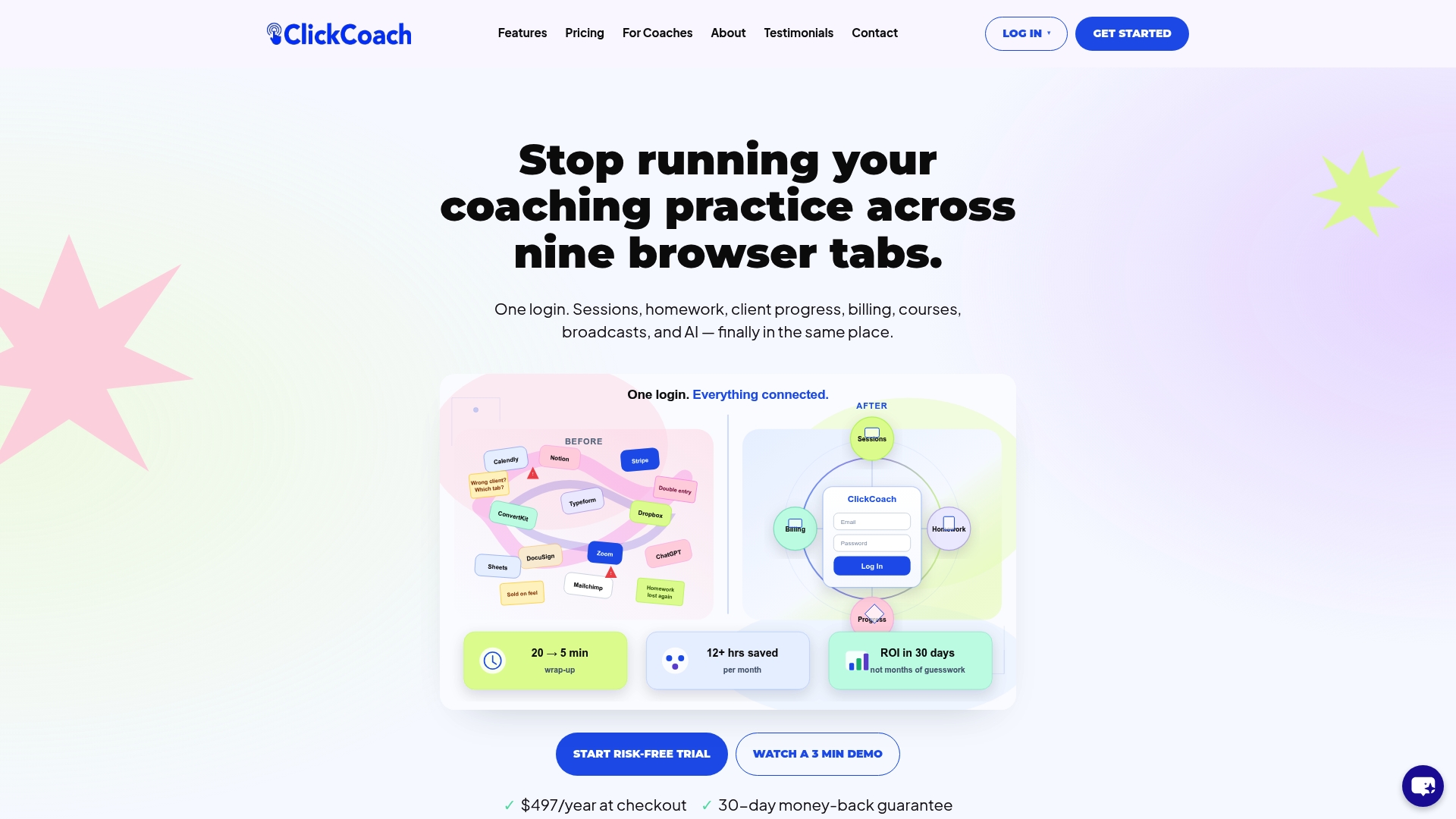
ClickCoach’s AI assists with drafting homework and follow-up messages, so you spend less time writing and more time coaching. Automated reminders handle session prep and resource delivery, keeping clients engaged without adding to your workload. Coaches save up to 20 minutes per session by working from one place instead of five. If you are ready to replace the chaos of scattered apps with a system that works, explore ClickCoach and see how it fits your practice.
FAQ
What is the best way to communicate with coaching clients?
Use a defined channel system: email for detailed questions, your coaching platform for session notes and homework, and text only for urgent logistics. Pair this with a clear 24-business-hour response promise to set expectations from day one.
How often should a coach check in with clients between sessions?
At least one substantive touchpoint between sessions is the professional standard. A mid-week check-in, progress prompt, or brief resource share keeps clients connected to their goals and reduces dropout.
How do coaches set communication boundaries without losing clients?
Define message windows, create an emergency protocol, and communicate both clearly during onboarding. Clear boundaries build trust rather than erode it, because clients know exactly what to expect.
What are the best client engagement strategies for coaches?
Planned milestone celebrations, scheduled resource sharing, visible progress tracking, and renewal conversations starting 30 days before contract end are the most effective client engagement strategies for coaches.
How does automation help with coaching communication?
Automation handles routine messages like session reminders and resource delivery, solving the “I forgot to follow up” problem. This frees coaches to focus personal attention on the conversations that require real presence and judgment.